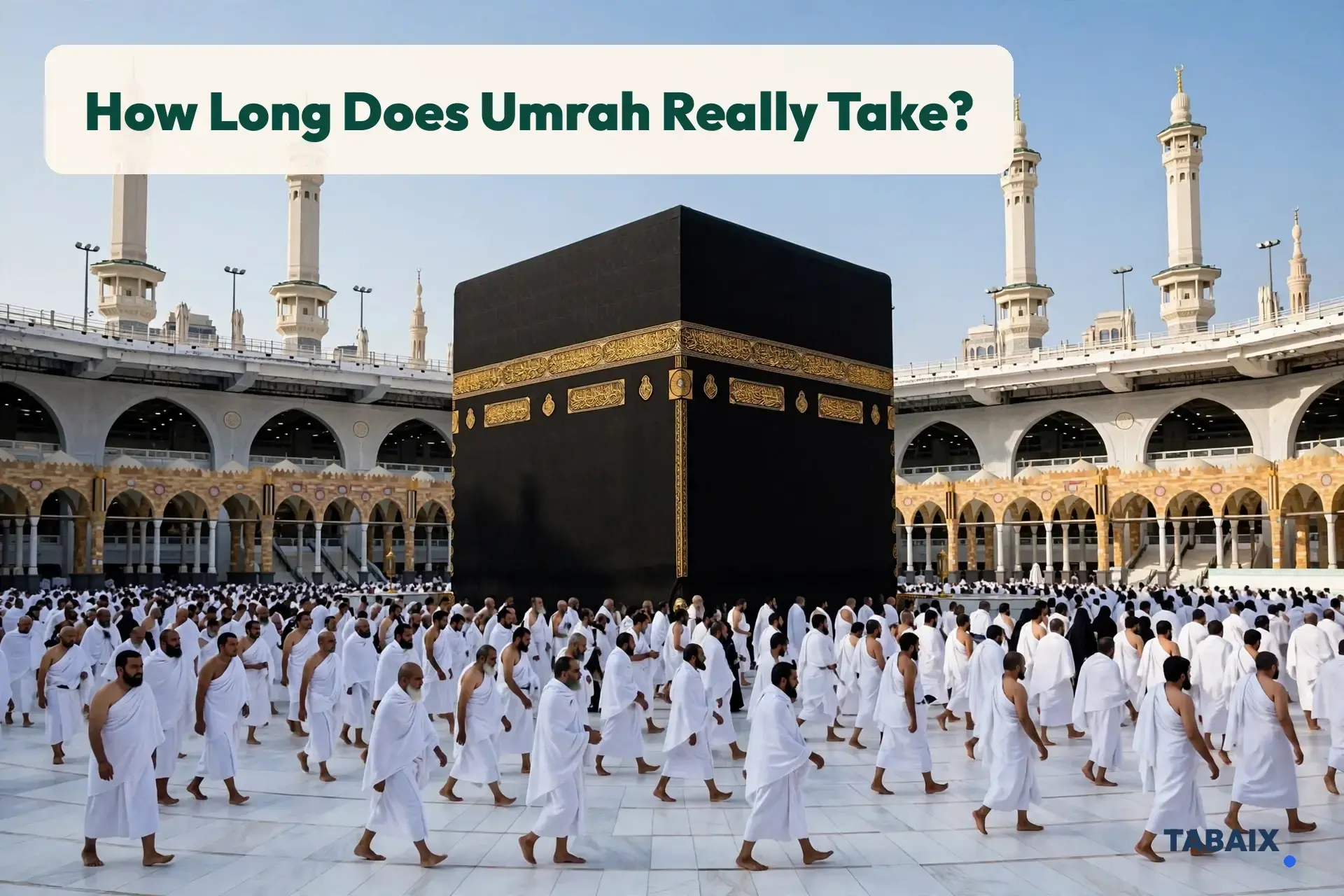
If you have never done Umrah before, the whole thing can feel bigger than it is. You land in Jeddah, you hear words like miqat, tawaf and sa’i, and everyone around you seems to know exactly where to go. I have been through it and I live in Riyadh, so this guide is written the way I wish someone had written it for me: the rituals in order, what each step actually looks like on the ground, and the practical Saudi side that most guides skip — the airport, the road to Makkah, where to stay, and what it costs.
Umrah is the lesser pilgrimage. Unlike Hajj, which happens only on fixed days of the year, you can perform Umrah at any time. The rituals themselves take a few hours. Most first-timers do them in one visit to the Haram, and many do it on the same day they arrive. This post walks you through every step, from entering ihram to the final haircut, and answers the questions first-timers actually ask. Every dua you need is written out in this guide, in Arabic with a Roman transliteration, an Urdu translation and an English meaning, at the exact step where you read it — so you can follow along even if you cannot read Arabic.
What Is Umrah?
Umrah is a pilgrimage to Makkah. It has five main parts: entering the state of ihram, tawaf (circling the Kaaba seven times), praying two rak’ahs, sa’i (walking between the hills of Safa and Marwa seven times), and then shaving the head or trimming the hair. When the last step is done, your Umrah is complete and you leave the state of ihram.
The whole set of rituals is called the manasik of Umrah. You do not need to be a scholar to do it correctly. You need to know the order, the few things that are not allowed while you are in ihram, and where you are supposed to be at each step. That is what this guide covers.
One thing worth saying plainly: Umrah is not Hajj. Hajj is obligatory once in a lifetime for those who can afford it, and it happens only in Dhul-Hijjah. Umrah is voluntary, it can be done any day of the year, and you can do it more than once in a trip if you wish. A lot of the confusion first-timers feel comes from mixing the two up. They are different journeys with different rules.
Before You Leave Home
Most of the stress in Umrah comes from things you can sort out before you travel. Get these right and the rest of the trip is calm.
Visa and Nusuk
Start with the visa. The official platform is Nusuk (nusuk.sa), and it is the first place to check what applies to your passport. Many nationalities can apply for an Umrah e-visa online. If you already hold a valid US, UK or Schengen visa, you may be eligible for a visa on arrival. If neither route fits you, a licensed travel agent in your country can arrange the visa and often bundles it with flights and hotels.
Visa rules change. I am not going to quote a fee here that could be out of date by the time you read this — check Nusuk for the current fee and requirements for your nationality before you book anything. What does not change is the paperwork you will need: a passport valid for at least six months, a recent photo, and proof of your booking. Keep a printed copy of your visa and your hotel booking with your passport. The airport and the hotel both ask for them.
Also download the Nusuk app before you fly. It is where you manage your Umrah permit and bookings, and it saves you from hunting for links at the airport. Make sure your phone works in Saudi Arabia before you leave — either sort out roaming with your home network or plan to buy a Saudi SIM at the airport, which is what most visitors do.
What to Pack
Pack light. You will walk a lot in Makkah, and everything you carry, you carry through the Haram.
Ihram clothes (men): two pieces of plain white unstitched cloth — one to wrap around your waist and one to drape over your shoulders. Buy a proper set before you travel. The cheap thin ones go see-through when you sweat, and you will sweat. Take a belt or a money pouch that sits under the cloth. You will need somewhere to keep your phone, your hotel card and a little cash while your hands are free.
For women: your normal abaya and hijab. While you are in ihram you do not cover your face. Wear something comfortable and light — the Haram is air-conditioned inside, but the walk from your hotel to the Haram in summer heat is not.
Shoes: comfortable sandals that slip off easily. You will take them off every time you enter the mosque, so you want something you can carry in a small bag. Do not bring new shoes you have never walked in. The distance between Safa and Marwa alone is about three and a half kilometres over the seven lengths of sa’i, and you will walk much more than that in a day.
Unscented toiletries: while you are in ihram you cannot use perfume, scented soap or scented creams. Buy unscented soap and lip balm before you travel. Regular deodorant with fragrance counts too, so switch to an unscented one for the days of Umrah.
Small day bag: a light backpack or a drawstring bag for your sandals, a water bottle, your phone charger and your documents. Keep it small — you will carry it through tawaf and sa’i.
Medicines: whatever you take daily, plus something for headaches and heat. If you take prescription medicine, bring the prescription with you.
Money: Saudi Arabia runs on the Saudi Riyal. Cards are accepted almost everywhere, including taxis through ride-hailing apps and most shops near the Haram. Carry some cash anyway for small stalls, tips and the odd shop that is cash-only. Your phone with Apple Pay or Google Pay works in most places.
Power bank: your phone will be your map, your camera, your Nusuk app and your way of finding your group. A power bank is not optional.
Arriving in Jeddah — King Abdulaziz International Airport
Almost every Umrah pilgrim lands at King Abdulaziz International Airport in Jeddah. Makkah has no airport of its own, so Jeddah is the gateway, and the airport is built for this job. International flights mostly arrive at Terminal 1. Some Umrah charter flights use the Hajj Terminal, which is a separate building designed for large pilgrim groups — your booking will say which terminal you arrive at, so check before you fly.
Immigration at Jeddah is straightforward. Have your passport and visa ready. The queues move slowly when several flights land together, so do not plan anything tight for the first two hours after landing. After immigration you collect your bags, and then you have a decision to make about your SIM card. There are STC, Mobily and Zain counters in the arrivals hall selling tourist SIMs. They work, and they are the fastest way to get data. If you already sorted out roaming or an eSIM, you can walk straight past them.
There is one thing to know before you leave the airport: your miqat. The miqat is the boundary where you must enter the state of ihram. If you are flying into Jeddah to perform Umrah, you will cross a miqat in the air before you land. In practice this means you enter ihram before the plane reaches it — the cabin crew usually make an announcement about an hour before landing, and many pilgrims change into ihram at home or at their departure airport and make the intention on the plane. If your flight comes from the north, your miqat is Al-Juhfah. If you are travelling via Madinah first, your miqat is Dhul-Hulayfah, and you will enter ihram there when you leave Madinah for Makkah. If you are unsure which miqat applies to your route, ask your agent or check on the Nusuk app before your travel day. Getting this wrong is one of the most common first-timer mistakes, and it is entirely avoidable.
Money at the airport is easy. There are ATMs in arrivals and currency exchange counters, but the rates are not the best. If you need cash, take a small amount at the airport and use ATMs in the city for the rest. Your card will work at the airport shops and food outlets.
Getting from Jeddah to Makkah
Jeddah to Makkah is about 80 kilometres, and the road is a straight, well-kept highway. You have three realistic options, and the right one depends on your budget, your group size and the time of day.
The Haramain High Speed Railway is the fastest and most comfortable way. There is a station inside the airport at Terminal 1, and the train runs to Makkah in under an hour. It is air-conditioned, it has space for luggage, and it drops you at the Makkah station, from where you take a taxi or a shuttle to your hotel. Book your ticket on the official Haramain website or app before your travel day — trains sell out at peak times, especially in Ramadan and on weekend nights. Fares change with demand, so check the current price when you book rather than relying on an old figure.
A taxi or a ride-hailing car is the most flexible option. Uber and Careem both operate in Jeddah and Makkah, and the app shows you the fare before you confirm, which means no haggling at 2am after a long flight. A private taxi from the airport to Makkah is practical if you are a family or a group sharing the cost. Agree the price before you get in if you take a taxi from the rank instead of the app.
A bus or a group transfer is what most package tours use. If you booked a package, your transfer is probably already arranged, and someone will be waiting for you in arrivals with a sign. If you are travelling independently, there are also scheduled bus services between Jeddah and Makkah, and they are the cheapest option — but they are slower, they run on their own timetable, and they do not drop you at your hotel door.
For a first-timer arriving late at night, my honest advice is the train if you can get a ticket, and a ride-hailing car if you cannot. Both are simple, both are safe, and neither requires you to negotiate anything when you are tired. Avoid the touts at the arrivals exit offering cheap rides — they are not the cheapest by the time you arrive.
When you reach Makkah, the city is built around the Haram. Hotels near the Haram are the most expensive, but you walk to the mosque in minutes. Hotels further out, in Aziziyah for example, are cheaper and usually run free shuttle buses to the Haram. If you are older, travelling with children, or you know you will be tired after the rituals, stay close. The money you save on a cheaper hotel disappears quickly into taxis and tired legs.
Step 1 — Entering Ihram
Ihram is both the clothing and the state you enter. For men, the clothing is the two white unstitched cloths. For women, it is your normal modest dress. The state begins when you make the intention (niyyah) and say the talbiyah at the miqat.
Before you enter ihram, do these things: take a shower, trim your nails, remove unwanted hair, and put on your ihram clothes. Use unscented toiletries only, and do not apply perfume — not on your body, not on your clothes. This preparation is called the ghusl of ihram, and it is best done before you reach the miqat. Many people do it at home or at their hotel before flying.
At the miqat, pray two rak’ahs if you can. Then make your intention in your heart, and say it out loud — this is the dua of niyyah, the words that open your Umrah:
Dua of intention (niyyah) — read once, at the miqat
اللَّهُمَّ لَبَّيْكَ عُمْرَةً
Allahumma labbayka ‘umratan.
Urdu: اے اللہ! میں عمرہ کے لیے حاضر ہوں۔
English: “O Allah, here I am to perform Umrah.”
When: the moment you enter ihram at the miqat, right after the two rak’ahs. Say it once, with the intention in your heart. Men say it aloud; women say it quietly.
Then begin the talbiyah, the call you repeat on the way to Makkah:
Talbiyah — repeat often, from the miqat to Makkah
لَبَّيْكَ اللَّهُمَّ لَبَّيْكَ، لَبَّيْكَ لَا شَرِيكَ لَكَ لَبَّيْكَ، إِنَّ الْحَمْدَ وَالنِّعْمَةَ لَكَ وَالْمُلْكَ، لَا شَرِيكَ لَكَ
Labbayka Allahumma labbayk, labbayka la sharika laka labbayk, innal-hamda wan-ni’mata laka wal-mulk, la sharika lak.
Urdu: حاضر ہوں، اے اللہ! حاضر ہوں۔ حاضر ہوں، تیرا کوئی شریک نہیں، حاضر ہوں۔ بے شک تمام تعریف اور نعمتیں تیرے لیے ہیں، اور بادشاہت بھی تیری ہے، تیرا کوئی شریک نہیں۔
English: “Here I am, O Allah, here I am. Here I am, You have no partner, here I am. Verily, all praise and blessings are Yours, and all sovereignty. You have no partner.”
When: from the moment you enter ihram until you begin tawaf. Repeat it often — while walking, in the car, on the train. Men say it aloud; women say it quietly, so only they can hear it. You stop saying the talbiyah when you begin tawaf.
While you are in ihram, some ordinary things are not allowed: perfume and scented products, cutting your hair or nails, covering your head (men), wearing stitched clothing (men), hunting, and marital relations. Women do not cover their faces while in ihram. If you forget and do something by mistake, it does not ruin your Umrah — ask a scholar at the Haram if you are unsure, because the rules have specific remedies and the details depend on what happened. Do not let worry about this distract you. Millions of people enter ihram every year and manage it fine.
Men should also know about idtiba. During tawaf, men wear the upper ihram cloth so that the right shoulder is uncovered and the left shoulder is covered. You put it on this way before you start tawaf, not before. It is a small thing and easy to get wrong the first time — watch what the men around you do, or ask someone. Nobody will mind.
Step 2 — Tawaf Around the Kaaba
Tawaf means circling the Kaaba seven times. You walk counter-clockwise, with the Kaaba on your left, starting and ending at the Black Stone (Hajar al-Aswad), which sits in the eastern corner. One complete circle is one circuit, and seven circuits make one tawaf.
Enter the Haram through any gate — the main gates get crowded after prayers, so if you arrive at a busy time, walk a little further to a quieter gate. The ground floor courtyard around the Kaaba is called the Mataaf. This is where tawaf happens. The ground floor is closest to the Kaaba but also the busiest. The upper floors are calmer, and the roof is the calmest of all, though it is a much longer walk each circuit. For a first-timer, the ground floor is the most moving experience, but if you struggle with crowds or you are with elderly parents, the first floor is a better choice. There is no reward difference for the floor you choose.
Start at the Black Stone. You will see a line of green lights on the floor marking it, and the corner of the Kaaba with the silver frame around the stone. If you can reach it, touch it or kiss it — but only if you can do so without pushing or harming anyone. In practice, at busy times, almost nobody can reach it, and that is completely fine. The rule is clear: if you cannot reach it, simply stand facing it, raise your right hand toward it and say:
بِسْمِ اللَّهِ، اللَّهُ أَكْبَرُ
Bismillah, Allahu Akbar — “In the name of Allah, Allah is the Greatest.”
Say this at the start of every circuit, each time you pass the Black Stone. Do not push. The people who shove their way to the stone are doing something wrong, not something pious.
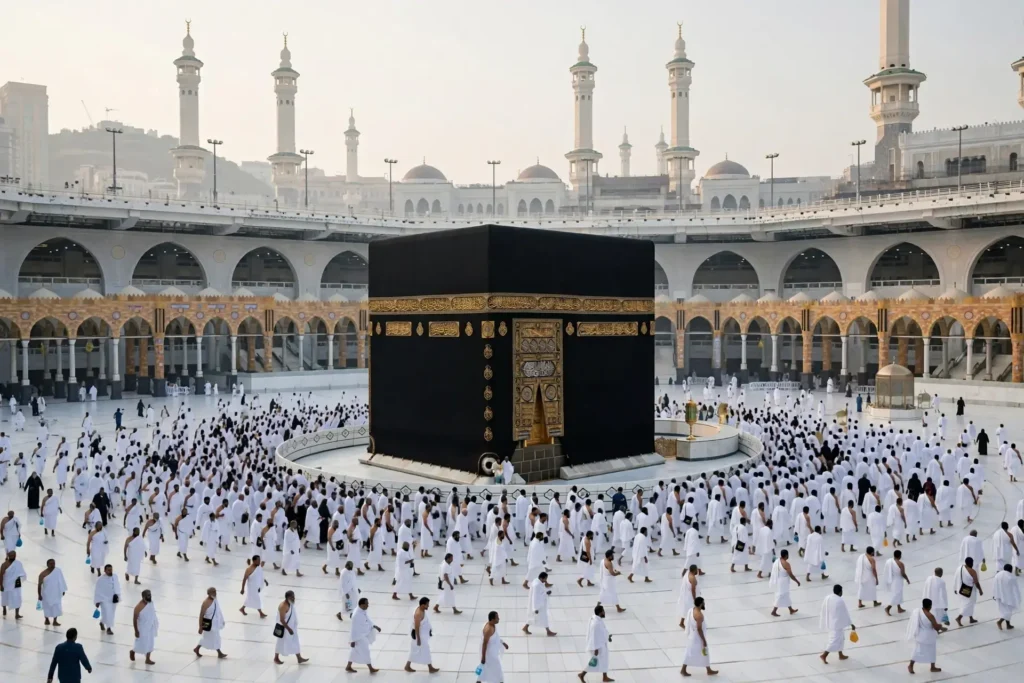
Then begin walking. Walk at a normal, calm pace. Men do raml during the first three circuits of this tawaf — a brisk, short-stepped walk, shoulders moving with each step — and walk normally for the remaining four. There is no set dua for tawaf. You can make any dua you like, in any language, in your own words. Many people read du’as from a small book, and that is fine. Others simply talk to Allah about what they need. Both are correct. One dua, though, is read at the same place in every single circuit — between Rukn Yamani, the Yemeni corner (the corner you reach just before the Black Stone), and the Black Stone itself:
Dua between Rukn Yamani and the Black Stone — every circuit (Quran 2:201)
رَبَّنَا آتِنَا فِي الدُّنْيَا حَسَنَةً وَفِي الْآخِرَةِ حَسَنَةً وَقِنَا عَذَابَ النَّارِ
Rabbana atina fid-dunya hasanatan wa fil-akhirati hasanatan wa qina ‘adhaban-nar.
Urdu: اے ہمارے رب! ہمیں دنیا میں بھی بھلائی عطا فرما اور آخرت میں بھی بھلائی عطا فرما، اور ہمیں آگ کے عذاب سے بچا لے۔
English: “Our Lord, give us good in this world and good in the Hereafter, and protect us from the punishment of the Fire.”
When: on every circuit, in the short stretch between the Yemeni corner and the Black Stone. It is the one place in tawaf where the same dua is read each time — learn it before you travel and the walk will carry itself.
Seven circuits take about 30 to 45 minutes on a quiet floor, and longer when it is crowded. Do not rush. If you lose count, go with the lower number you are sure of and complete the rest — it is better to be sure than to guess. If you need a break, step out of the flow to the side, rest, and rejoin. Children in the Mataaf is normal; keep them close and hold their hands in the crowd.
When you finish the seventh circuit, your tawaf is done. Move out of the Mataaf to a quieter area for the next step.
Step 3 — Pray at Maqam Ibrahim and Drink Zamzam
After tawaf, pray two rak’ahs. The recommended place is behind Maqam Ibrahim, the stone bearing the footprints of Ibrahim (peace be upon him) that stands a few metres from the Kaaba. As you stand there, before the two rak’ahs, recite this verse:
Verse at Maqam Ibrahim — before the two rak’ahs (Quran 2:125)
وَاتَّخِذُوا مِن مَّقَامِ إِبْرَاهِيمَ مُصَلًّى
Wattakhidhu min maqami Ibrahima musalla.
Urdu: اور مقامِ ابراہیم کو نماز کی جگہ بنا لو۔
English: “And take the station of Abraham as a place of prayer.”
When: after tawaf, as you stand behind Maqam Ibrahim (or wherever you find space to pray the two rak’ahs, when the area behind it is packed). Recite it once, then pray the two rak’ahs.
At busy times the area behind Maqam Ibrahim is packed, so pray wherever you can find space in the Haram — the two rak’ahs are valid anywhere in the mosque. Read Surah Al-Kafirun in the first rak’ah and Surah Al-Ikhlas in the second, which is the recommended practice, or read whatever you know.
Then drink Zamzam water. You will find Zamzam taps and coolers all over the Haram, marked clearly, and cups next to them. Drink your fill, standing or sitting, facing the Kaaba, and make this dua as you drink:
Dua on drinking Zamzam — facing the Kaaba
اللَّهُمَّ إِنِّي أَسْأَلُكَ عِلْمًا نَافِعًا وَرِزْقًا وَاسِعًا وَشِفَاءً مِنْ كُلِّ دَاءٍ
Allahumma inni as’aluka ‘ilman nafi’an wa rizqan wasi’an wa shifa’an min kulli da’.
Urdu: اے اللہ! میں تجھ سے نفع بخش علم، وسیع رزق اور ہر بیماری سے شفا مانگتا ہوں۔
English: “O Allah, I ask You for beneficial knowledge, abundant provision, and healing from every illness.”
When: while you drink Zamzam, facing the Kaaba. You can also make any dua in your own words — Zamzam is drunk for whatever intention you make with it. There is no fixed amount to drink. Fill a bottle to take back to your hotel — you will want it later in the day, and Zamzam is given freely inside the Haram.
One honest warning: the Zamzam coolers near the Mataaf get very crowded right after prayers. If you see a queue of fifty people, walk to a cooler on an upper floor or in a side hall. The water is the same everywhere, and you will save yourself twenty minutes.
Taking Zamzam home is a separate question. Sealed Zamzam is sold at Jeddah airport, and most airlines allow one sealed 5-litre bottle as checked baggage. The rules differ by airline and they change, so check with your airline before your return flight. We have a separate guide on taking Zamzam water on flights from Saudi Arabia if you want the detail.
Step 4 — Sa’i Between Safa and Marwa
Sa’i is the walk between the two hills of Safa and Marwa, inside the Haram. It has seven lengths. A length from Safa to Marwa counts as one, and a length from Marwa back to Safa counts as the next. So you start at Safa and finish at Marwa after seven lengths.
Go to Safa first. It is the small hill inside the mosque at one end of the sa’i corridor. Stand there, face the Kaaba, raise your hands and begin with this verse, recited once:
Verse at Safa — before you begin sa’i (Quran 2:158)
إِنَّ الصَّفَا وَالْمَرْوَةَ مِن شَعَائِرِ اللَّهِ
Innas-Safa wal-Marwata min sha’a’irillah.
Urdu: بے شک صفا اور مروہ اللہ کی نشانیوں میں سے ہیں۔
English: “Indeed, Safa and Marwa are among the symbols of Allah.”
When: at Safa, before your first length — stand facing the Kaaba and recite it once.
Then say this dhikr three times, making your own personal dua between each repetition:
Dhikr on Safa — three times, with your own dua between
لَا إِلَهَ إِلَّا اللَّهُ وَحْدَهُ لَا شَرِيكَ لَهُ، لَهُ الْمُلْكُ وَلَهُ الْحَمْدُ، وَهُوَ عَلَى كُلِّ شَيْءٍ قَدِيرٌ، لَا إِلَهَ إِلَّا اللَّهُ وَحْدَهُ، أَنْجَزَ وَعْدَهُ، وَنَصَرَ عَبْدَهُ، وَهَزَمَ الْأَحْزَابَ وَحْدَهُ
La ilaha illallahu wahdahu la sharika lah, lahul-mulku wa lahul-hamd, wa huwa ‘ala kulli shay’in qadir. La ilaha illallahu wahdah, anjaza wa’dah, wa nasara ‘abdah, wa hazamal-ahzaba wahdah.
Urdu: اللہ کے سوا کوئی معبود نہیں، وہ اکیلا ہے، اس کا کوئی شریک نہیں، بادشاہت اسی کی ہے، اور تمام تعریف اسی کے لیے ہے، اور وہ ہر چیز پر قادر ہے۔ اللہ کے سوا کوئی معبود نہیں، وہ اکیلا ہے، اس نے اپنا وعدہ پورا کیا، اپنے بندے کی مدد فرمائی، اور تنہا تمام لشکروں کو شکست دی۔
English: “There is no god but Allah alone, with no partner. To Him belongs the kingdom and to Him belongs all praise, and He has power over all things. There is no god but Allah alone. He fulfilled His promise, helped His servant, and defeated the confederates alone.”
When: on Safa, before you start walking — three times, with your own dua between each one. Do the same at Marwa at the end of each length: the same dhikr, three times, with your own dua between. This is the dua of the hills, and it is the heart of sa’i — take your time with it, and ask Allah for what you need.
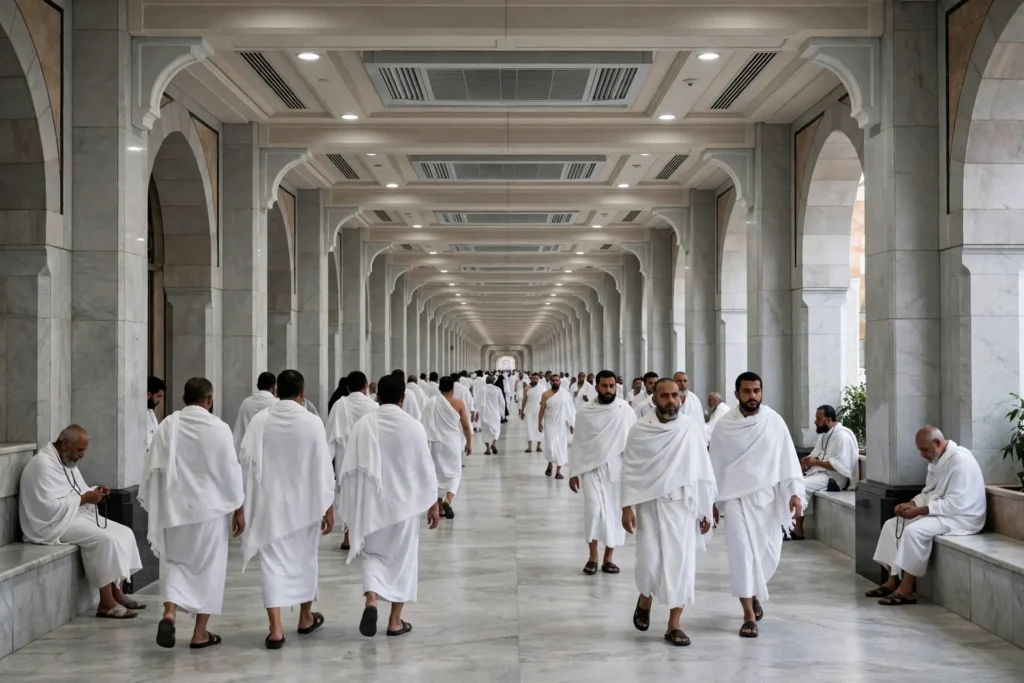
Then begin walking toward Marwa. The corridor is long, air-conditioned and signposted. There are two green lights along the way, and between them men should walk briskly — a light jog if you can manage it, a fast walk if you cannot. Women walk at a normal pace all the way through. Outside the green lights, everyone walks normally.
Each length is about 400 metres, so the full sa’i is roughly three and a half kilometres. That sounds a lot, and it is, but the floor is flat, the air is cool, and there are places to sit along the way. Take it slowly. There is no time limit. If you need to rest, sit down at the side and continue when you are ready.
Wheelchairs are available for sa’i, and the sa’i area has floors set aside for wheelchair users. If you are pushing an elderly parent, the upper floors are calmer and the staff will guide you. You can also hire a wheelchair with an attendant at the Haram if you need one.
At the end of each length, pause briefly at the hill, face the Kaaba and say the dhikr above three times, with your own dua between each repetition, then turn and walk back. When you reach Marwa for the seventh time, your sa’i is complete. The green lights and the signs make it hard to get lost, and the people around you are almost all doing exactly the same thing — follow the flow and count your lengths on your fingers or on a small counter.
Step 5 — Halq or Taqsir: Completing Your Umrah
The last step is the haircut. Men have two options: shaving the whole head (halq) or trimming the hair (taqsir). Shaving is the better of the two. Women trim a fingertip’s length from the ends of their hair. You do this after sa’i, and once it is done, your Umrah is complete and you leave the state of ihram. Your normal clothes, perfume and everything else become allowed again. There is no specific dua for the haircut, so none is given here — simply make any dua you like in your own words as your Umrah is completed.
There are barber shops just outside the Haram, and they know exactly what to do. A shave takes a few minutes. Agree the price before you sit down — the shops near the Haram are busy and the prices vary by season. Women normally trim their own hair at the hotel, because there are no women’s barbers in the Haram area.
One practical note: do not get your hair cut while you are still in ihram before sa’i is finished. The order matters. Ihram, tawaf, prayer, Zamzam, sa’i, then the haircut. If you do the haircut early by mistake, ask a scholar at the Haram — there are offices inside the mosque for exactly this kind of question, and they will tell you what to do. Do not let it spoil the day. These things happen to first-timers all the time.
How Long Does Umrah Take?
This is the question almost every first-timer asks, and the honest answer is that the rituals themselves take between two and four hours. Tawaf takes about 30 to 45 minutes when it is not crowded, and up to two hours at peak times. Sa’i takes about 45 minutes to an hour at a normal walking pace. Add the two rak’ahs, Zamzam, the walk to the barber and the haircut, and a relaxed Umrah is about three hours from entering the Haram to leaving it.
That does not count the rest of the day. You will spend time getting to the Haram, waiting after prayers, resting between steps and finding your group again. Most people plan a full half day for their first Umrah. If you arrive in Jeddah in the morning, you can realistically be in Makkah, rested and in ihram by the afternoon, and finished by the evening prayer. If you arrive late at night, sleep first and do your Umrah after Fajr — the Haram is quietest in the hours after dawn prayer and late at night, and the heat is lowest then.
Can you do Umrah in one day? Yes, and many people do. You can fly into Jeddah in the morning, take the train to Makkah, perform Umrah in the afternoon and fly back the same night. It is a long day and you will be tired, but it is entirely possible. If you can spare two days, take them. The first day for Umrah, the second to rest, pray in the Haram at your own pace and visit Madinah if your schedule allows. Umrah is an act of worship, not a race, and the people who enjoy it most are the ones who give themselves time.
The busiest times are Ramadan, the school holiday weeks and the December to January period. In those weeks, tawaf can take two hours and the Mataaf is shoulder to shoulder. If you can choose your dates, the quietest months are usually the weeks just after Hajj season and the hottest part of summer — but summer means walking to the Haram in 45-degree heat, so that trade-off is not free either.
Common Mistakes First-Timers Make
Entering ihram at the wrong place. This is the most common one. If you fly into Jeddah, your miqat is in the air. Do not wait until you land in Jeddah to enter ihram — by then you have already passed it. Enter ihram before the flight crosses the miqat. If you go to Madinah first, enter ihram at Dhul-Hulayfah when you leave Madinah. Ask before your travel day, not on the plane.
Pushing to touch the Black Stone. The crowd around the Black Stone is the roughest place in the Haram. People get hurt there. The ruling is clear: if you cannot reach it easily, point at it and say Allahu Akbar. You lose nothing.
Losing count during tawaf or sa’i. It happens to everyone at least once. Count on your fingers, or use a small counter, or count the circuits by which corner you are passing. If you lose count, take the lower number you are sure of and finish from there.
Wearing new shoes. Sa’i is three and a half kilometres. Blisters on day one ruin the rest of the trip. Wear sandals you have already walked in.
No water, no rest. The Haram has water everywhere, but people forget to drink. Drink Zamzam, carry a bottle, and sit down when you need to. Nobody is keeping score of your speed.
Leaving your group without a meeting point. The Haram is enormous, and phone signal inside is unreliable at busy times. Agree a meeting point and a time before you enter — a gate number, a shop name outside, something specific. “Meet at the entrance” does not work when there are a hundred entrances.
Spending the whole trip shopping. The malls around the Haram are tempting, and a few gifts are fine. But if you spend your days in the mall, you have spent your Umrah money on shopping. Do the rituals first, rest, pray, and shop on the last day if you have time.
What Umrah Costs — A Realistic Budget
Umrah costs what your choices cost. There is no fixed price, and anyone who quotes you one number for “Umrah” is selling you something. Here is how the money actually breaks down, so you can build your own budget.
Visa and permits. The Umrah visa fee is set by the Saudi authorities and changes from time to time. Some nationalities pay nothing extra beyond the application if they hold other valid visas. Check Nusuk for the current fee for your passport before you book — this is one number you should never take from an old blog post, including this one.
Flights. This is usually the biggest single cost. It depends on where you fly from, when you book and the season. Flights from Pakistan, India and Bangladesh in Ramadan cost far more than the same flights in a quiet month. Book early, compare, and remember that a cheap flight with a long layover can cost you a day of your trip.
Transport in Saudi Arabia. The Haramain train from Jeddah airport to Makkah is priced on the official booking site, and fares rise at busy times. A ride-hailing car shows you the fare in the app before you confirm. A bus is the cheapest option. None of these is expensive compared with the flight — the mistake is not budgeting for the return trip as well as the trip in.
Hotel. This is where the range is widest. A room within a few minutes’ walk of the Haram costs several times more than a room in Aziziyah with a shuttle bus. For a first-timer, especially with elderly parents, the walk matters more than the room size. Book on a known platform, check the distance to the Haram on the map rather than trusting “near Haram” in the listing, and confirm whether the hotel runs its own shuttle.
Food. You can eat well in Makkah for very little. The food courts and the restaurants around the Haram range from simple meals to full restaurants. A day’s food for one person is one of the smallest lines in the budget, which is why most packages include breakfast and leave the rest to you.
The haircut, Zamzam and small things. The barber’s fee, a bottle or two of Zamzam, a prayer mat or a small gift — these are small amounts that add up if you do not track them. Carry a little cash for them.
A rough way to think about it: for most pilgrims, the flight is the biggest cost, the hotel is the second, and everything else together — visa, transport, food and the small things — is the third. If you are counting Riyals, start with the flight and the hotel, and the rest will fall into place. Verify every price live before you pay, because Umrah prices move with the season.
Practical Tips Summary
Best time to do Umrah: After Fajr prayer and late at night are the quietest times in the Haram. Avoid the hours right after Maghrib and Isha when it is busiest. In summer, do the outdoor walking parts — the walk from the hotel, the rooftop tawaf — early in the morning or after sunset.
Crowds: The ground floor Mataaf is the most moving and the most crowded. The first floor and the roof are calmer. Ramadan, school holidays and December to January are the busiest periods — tawaf can take two hours then.
Shoes and bags: Wear slip-off sandals and carry them in a small bag. Keep your day bag small and keep your passport and phone in a pouch under your ihram, not in a back pocket.
Water and rest: Drink Zamzam from the coolers and carry a bottle. Sit and rest between steps whenever you need to — there is no time limit on any of the rituals.
Meeting point: Agree a specific gate number or landmark with your group before you enter the Haram. Phone signal is unreliable inside at busy times.
Money: Cards work almost everywhere, but carry some cash for small shops and the barber. Check the fare in the app before you confirm a ride, and check the train fare on the official site before your travel day.
Children and elderly parents: Children are welcome in the Haram. Keep them close in the Mataaf. For elderly parents, use the upper floors for tawaf, the wheelchair floors for sa’i, and stay in a hotel close to the Haram if you can.
What to check before you travel: Visa route and fee on Nusuk, your flight terminal at Jeddah, your miqat for your route, your hotel’s distance to the Haram and whether it runs a shuttle, and your airline’s Zamzam baggage rule for the way home.
FAQ
The rituals themselves take between two and four hours: tawaf about 30 to 45 minutes when it is quiet, sa’i about 45 minutes to an hour, plus the two rak’ahs, Zamzam and the haircut. Plan a full half day for your first Umrah, including getting there and resting between steps.
Yes. Many people fly into Jeddah in the morning, take the train to Makkah, perform Umrah in the afternoon and fly back the same night. It is a long day. If you can spare two days, take them — the first for Umrah and the second to rest and pray in the Haram at your own pace.
Umrah is the lesser pilgrimage and can be done any time of year. Hajj is obligatory once in a lifetime for those who can afford it and happens only on fixed days in Dhul-Hijjah. Umrah has five steps — ihram, tawaf, prayer, sa’i and the haircut — while Hajj has many more rites spread over several days.
Most visitors need one. Many nationalities can apply for an Umrah e-visa through Nusuk, and holders of valid US, UK or Schengen visas may be eligible for a visa on arrival. Check the current route and fee for your passport on nusuk.sa before you book.
You cross a miqat in the air before you land, so you enter ihram before the plane reaches it. The cabin crew usually announce it about an hour before landing. If you travel via Madinah first, your miqat is Dhul-Hulayfah, and you enter ihram when you leave Madinah for Makkah.
Women can travel for Umrah, and many do. The rules on travelling companions have been relaxed in recent years — check the current requirement for your nationality on Nusuk before you book. In the Haram there are separate prayer areas for women, and women do not cover their faces while in ihram.
Ihram clothes (men) or abaya (women), comfortable slip-off sandals, unscented toiletries, a small day bag, a power bank, your medicines, your passport and visa printout, and some cash in Saudi Riyal. Pack light — you will carry everything through the Haram.
The Haramain High Speed Railway runs from a station inside the airport at Terminal 1 to Makkah in under an hour. A ride-hailing car through Uber or Careem shows you the fare before you confirm. Buses are the cheapest option. If you booked a package, your transfer is probably already arranged.
Six, and they are all in this guide at the exact step where you read them: the niyyah and talbiyah at the miqat, the dua between Rukn Yamani and the Black Stone in every circuit of tawaf, the verse at Maqam Ibrahim, the Zamzam dua, and the verse and dhikr at Safa and Marwa. Each one is given in Arabic, with a Roman transliteration, an Urdu translation and an English meaning. There is no set dua for tawaf itself — you make your own dua in any language — and there is no specific dua for the haircut at the end.
Written November 2026. Ritual steps follow the standard order of Umrah. Visa fees, train fares and hotel prices change — verify them live on nusuk.sa and the official booking sites before you travel.