Ask ten people what a Saudi visa costs and you will get ten different answers. One says SAR 300, another says SAR 535, a third says SAR 395, and someone’s cousin paid an agent three times any of those. I spent a day checking the official Saudi visa platforms — KSA Visa, the Visit Saudi eVisa portal, MOFA and Nusuk — and the reason for the confusion is simple: there is no single “Saudi visa price”. The government fee is one line, the insurance is another, the digital service fees are two more, and the total you pay depends on which visa you pick and which portal you apply through. This post untangles all of it, with the exact figures I verified on 16 November 2026, and it tells you honestly where no official figure exists at all.
The Short Answer: Saudi Visa Prices at a Glance
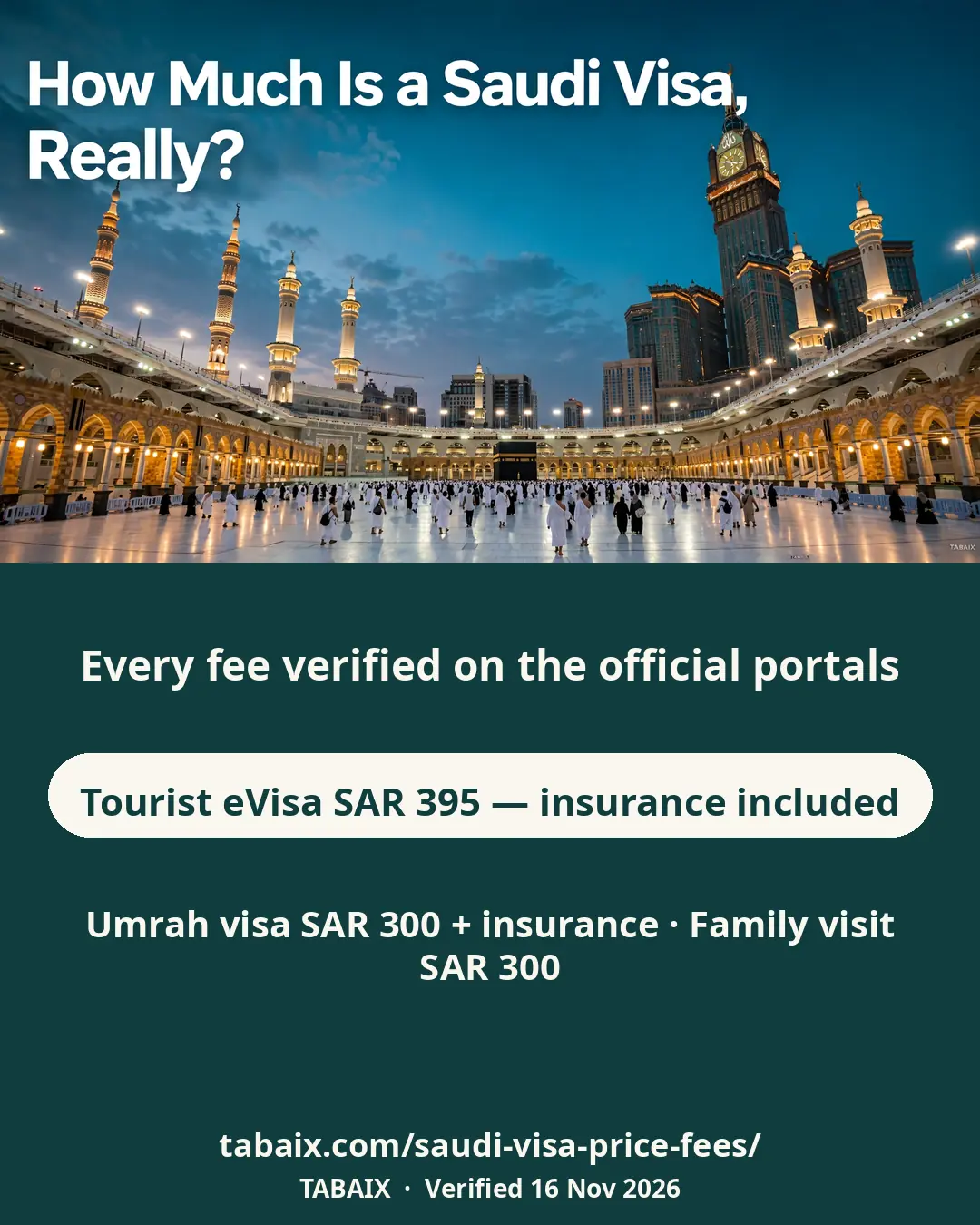
If you only want the numbers, here they are. Every figure below is the government fee or the official portal price, not an agent’s quote. Insurance is mandatory on every route, so the “what you actually pay” column is the number that matters for your budget.
| Visa | Government fee | Insurance | What you actually pay | Validity and stay |
|---|---|---|---|---|
| Tourist eVisa (eligible nationalities) | SAR 300 | Included | SAR 395 | 1 year, multiple entry, up to 90 days per stay |
| Tourist eVisa, GCC-resident route | SAR 300 | Extra, priced at checkout | SAR 339.44 + insurance | 1 year, multiple entry, up to 90 days per stay |
| Visa on arrival | SAR 300 | Included | SAR 395 | Same as the eVisa |
| Umrah visa (dedicated) | SAR 300 | SAR 100–180 | SAR 400–480 | Up to 90 days; enter within 30 days of issue |
| Family visit visa | SAR 300 | Extra, priced at checkout | SAR 300 + insurance + small charges | Single entry up to 3 months, or multiple entry up to 1 year |
| Business visit visa | SAR 300 | Extra, priced at checkout | SAR 300 + insurance + small charges | Decided by the embassy |
| UK Electronic Travel Authorisation (ETA) | SAR 50 | Not included | SAR 50 + insurance | 2 years, multiple entry, 180 days in total |
| Work visa (permanent, temporary, seasonal) | No standalone fee published | Employer-arranged | No official figure | Employer and contract decide |
Two things jump out of that table. First, the government visa fee is SAR 300 on almost every route — the same SAR 300, whether you are coming for tourism, Umrah or a family visit. Second, the number that changes your budget is never the visa fee. It is the insurance, the digital service fees, and — for Umrah — the package you must buy with the visa. Keep that in mind for the rest of this post, because every “cheap visa” story you hear is really a story about one of those three extras.
The One Thing That Confuses Everyone: Visa Fee vs Total Cost
The single biggest misunderstanding about Saudi visa prices is the gap between the visa fee and the total cost. The Saudi government charges SAR 300 for the visa itself. That is the fee set by the Council of Ministers, and it is the same on the KSA Visa platform whether you apply for tourism, a family visit, business or Umrah. But SAR 300 is not what leaves your bank account, because the checkout adds three more lines before you pay.
On the KSA Visa platform (ksavisa.sa), the checkout for a visit visa shows four lines. The visa fee is USD 80, which is SAR 300. Then there is a visa digital services fee of USD 10.50, an insurance digital services fee of USD 10.50, and the medical insurance premium itself, which the insurer prices according to your age and the length of your stay. The three fixed fees add up to USD 101 — about SAR 379 — before insurance. That USD 101 figure is what the platform itself lists, and I verified it against two independent checks of the official platform made in November 2026.
On the Visit Saudi eVisa portal (visa.visitsaudi.com), the pricing works differently. The portal lists one flat price — SAR 395 — and that price already includes the medical insurance. You pay one amount and you are done. That is why you will see SAR 395 quoted for the tourist eVisa and SAR 300 quoted for the “same” visa on the KSA Visa platform. Both are correct. They are two different checkouts for two different routes, and the SAR 395 figure has the insurance inside it while the SAR 300 figure does not.
Then there is the SAR 535 figure, which still appears in older guides and plenty of travel blogs. That was the old all-in total: SAR 395 for the visa plus SAR 140 for insurance, back when the portal priced them separately. The Visit Saudi portal now lists SAR 395 with insurance included, so SAR 535 is out of date. If a guide still quotes SAR 535 as the current eVisa price, it has not been updated since the portal changed its pricing — and that is a good test of whether any visa guide you are reading is current.
The medical insurance deserves its own paragraph, because it is the line that surprises people most. It is compulsory on every Saudi visa, and you cannot opt out of it. On the eVisa portal it is bundled into the SAR 395. On the KSA Visa platform you choose an insurer at checkout and the premium depends on your age, your health answers and how long you are staying. Reported premiums run from around SAR 28 for a young traveller on a short trip to several hundred riyals for an older traveller or a long stay. For an Umrah visa, the insurance typically runs SAR 100 to SAR 180. The insurance on a family visit visa is bought after MOFA approves the application, and it covers emergency treatment up to SAR 100,000. Whatever the route, budget for the insurance on top of the SAR 300 unless the portal tells you it is included — and never believe an agent who quotes you a single “all-in” price without showing you the four lines.
One more line to watch for: VAT. The SAR 300 visa fee is quoted excluding VAT on some official pages, and the digital service fees are small enough that the difference is a few riyals. It is not the line that changes your budget. The lines that change your budget are insurance and, for Umrah, the package.
Tourist eVisa Price: SAR 395 (and When It Is SAR 339.44)
The tourist eVisa is the visa most readers of this blog will use, so let me pin its price down properly. If you hold a passport from one of the countries on the official eVisa list, you apply on the Visit Saudi eVisa portal, and the price is SAR 395 per person, with the application fee and the mandatory medical insurance included. That is the figure the Visit Saudi portal lists, confirmed by checks made in October 2026. You can also get the same visa on arrival at the airport — at the kiosks or at passport control — for the same SAR 395.
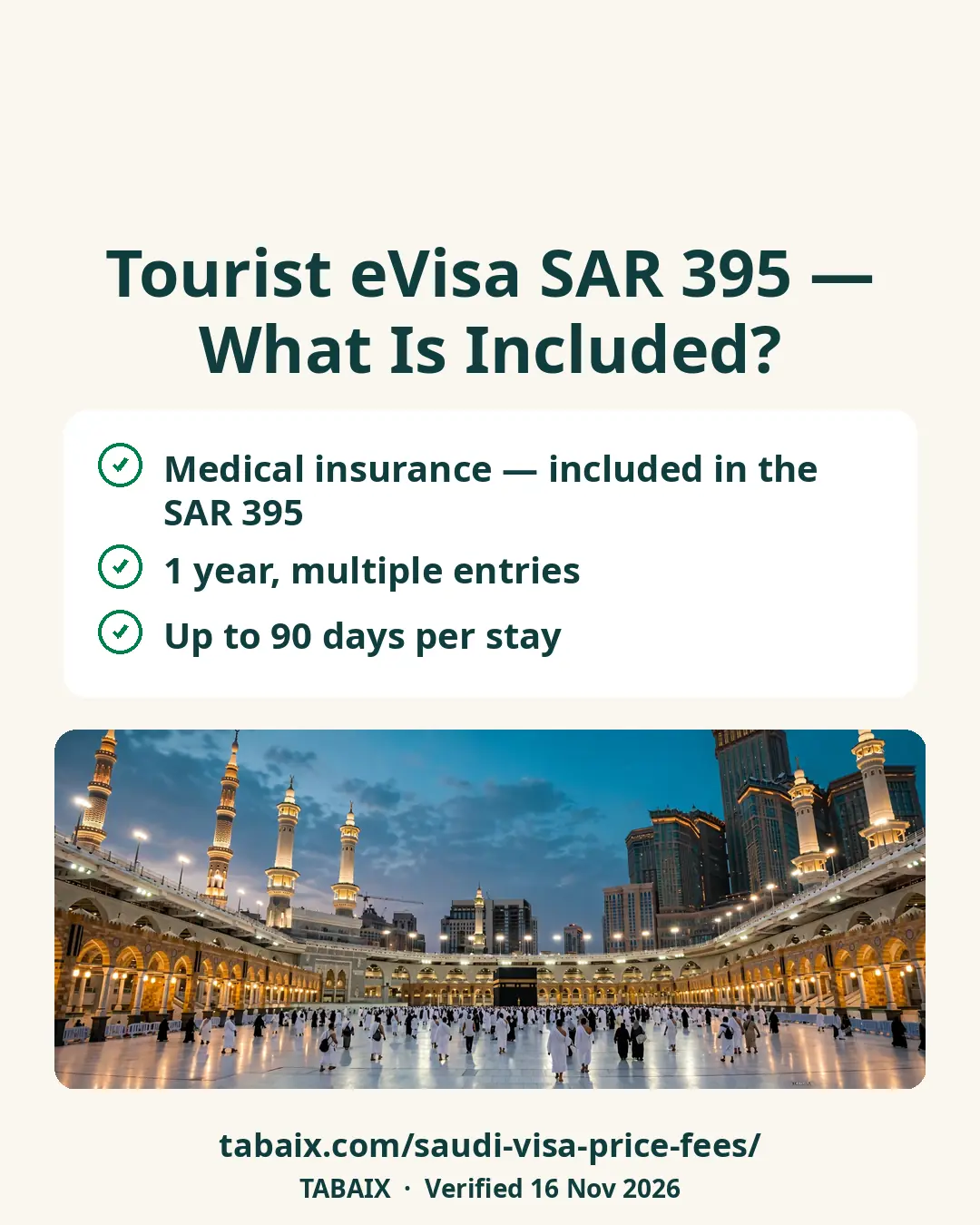
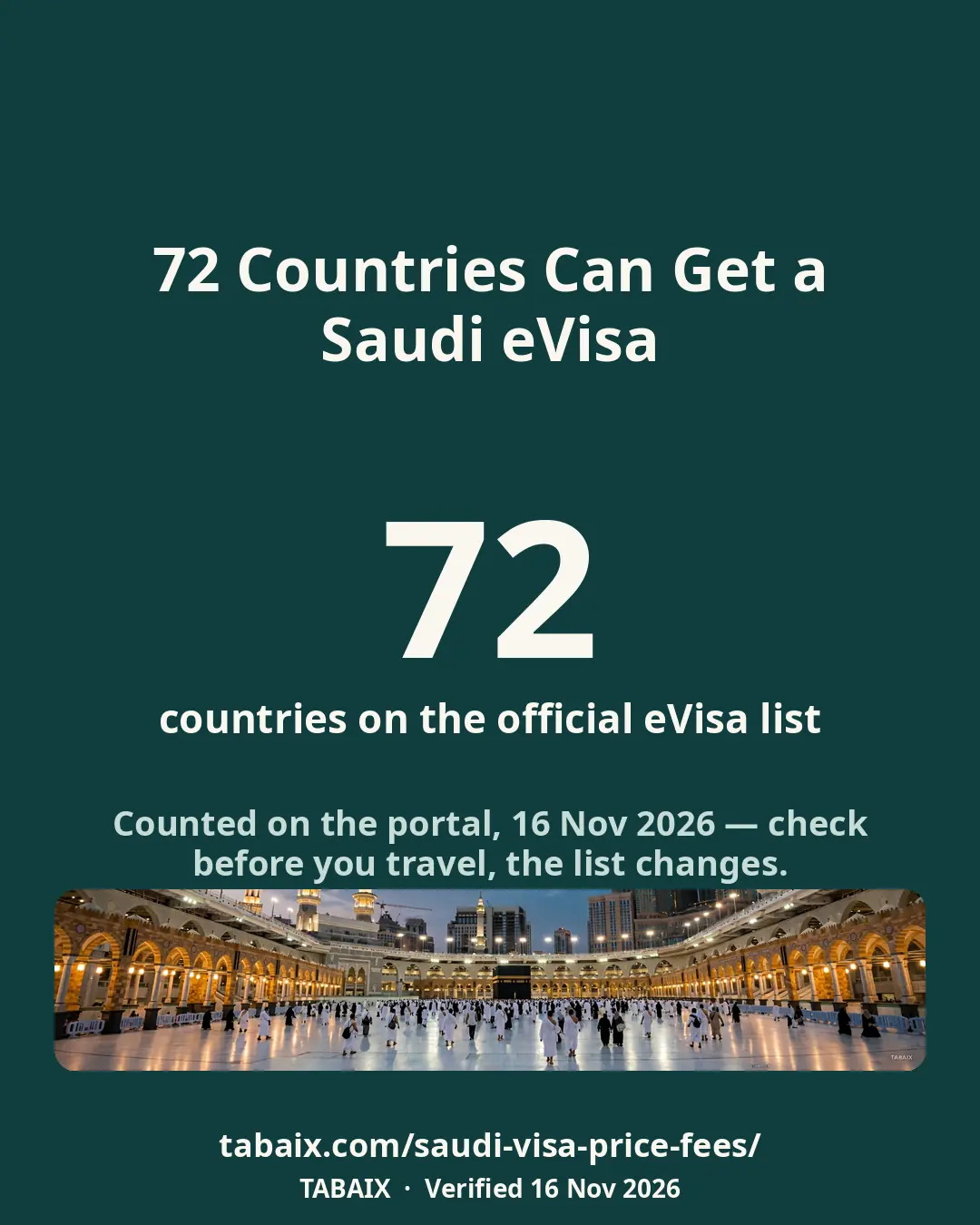
The eVisa is a one-year, multiple-entry visa, and you can stay up to 90 days on each visit. It covers tourism, leisure, events, visiting family and relatives, and Umrah outside the Hajj season. It does not cover studying, working or Hajj. The official portal currently lists 72 eligible countries — I counted the list on the portal itself on 16 November 2026, and it has grown since our earlier Umrah visa post listed 68, so treat 72 as the current figure and check the portal before you travel, because the list changes.
Pakistan is not on the eVisa nationality list, and neither is India. That matters more than the price, because it decides which portal you use. If your passport is not on the list, you cannot buy the SAR 395 eVisa by passport alone. There are two exceptions. If you hold a valid, already-used tourist or business visa for the United States, the United Kingdom or the Schengen area, or you hold permanent residence in the US, the UK or the EU, you can apply for the eVisa online or get it on arrival. And if you live in a GCC country on a residence permit, you can use the GCC-resident route on the KSA Visa platform. Everyone else applies through the KSA Visa platform for the visa type that fits their trip, or through an embassy or a visa centre.
The GCC-resident route has its own price, and this is where the second figure comes in. On the KSA Visa platform, the GCC-resident tourist visa is listed at SAR 339.44, and the medical insurance is not included — you pay for it separately at checkout. The Visit Saudi visa finder shows the same SAR 339.44 figure for this route. So if you live in Dubai, Doha or Kuwait City on a residence permit, your visa fee line will read SAR 339.44, and your total will be that plus whatever insurance you choose. The visa itself is the same one-year, multiple-entry visa with up to 90 days per stay.
There is also a single-entry version of the tourist eVisa, valid for three months. The portal does not make a fuss about it, because almost everyone takes the multiple-entry version for the same process. If you are only making one short trip and you are offered a single-entry visa, check the validity dates on it carefully — a three-month validity with a 90-day stay is very different from a one-year validity, and the price difference is not worth getting the dates wrong.
Umrah Visa Price: SAR 300 Plus Insurance (SAR 400–480)
The dedicated Umrah visa has the simplest official price of any Saudi visa, and the most complicated real cost. The government fee is SAR 300 — about USD 80 — and it is the same for every pilgrim, including infants. On top of that you pay mandatory medical insurance of roughly SAR 100 to SAR 180, depending on the provider and the cover. So the official visa total, before anyone else takes a fee, is SAR 400 to SAR 480. That is the figure in the Ministry of Hajj and Umrah’s own FAQ, and it is the figure every current guide that checked the official platform agrees on.
What has changed, and what changes the real cost, is the rule that has applied since August 2025: you can no longer get a standalone Umrah visa with nothing attached. Every Umrah visa must now be tied to a verified booking for your hotel and your transport, made through the Nusuk platform or a Ministry-approved provider, before the visa is issued. The visa fee stays at SAR 300, but the Nusuk package becomes mandatory overhead. Economy Nusuk packages start from around SAR 800 per person, and premium packages run far higher. When an agent quotes you an Umrah package price, the visa fee inside it is SAR 300 and the insurance is SAR 100 to SAR 180 — everything above SAR 480 is the package, the hotel, the transport and the agent’s own service charge. Ask for the breakdown in writing before you pay, and if the agent cannot show you the SAR 300 line, walk away.
Two rules about the Umrah visa catch people out, and both are more important than the price. The first is the 30-day entry window. Your Umrah visa must be used to enter Saudi Arabia within 30 days of the date it is issued, or it is automatically cancelled. The old 90-day entry window is gone. That means you book the visa close to your flight, not months ahead, and if your flight moves by more than a few weeks, your visa may already be dead. The government fee is not refunded when a visa is cancelled this way, so a date mistake costs you the full SAR 300 plus the insurance.
The second is the season. For the current 1448H season, Umrah visa issuance and pilgrim entry reopened on 31 May 2026 after the annual Hajj pause. The season runs until the last Umrah visa is issued on 9 March 2027, the last entry into the Kingdom is on 23 March 2027, and every Umrah-visa pilgrim must be out of the country by 7 April 2027. These dates come from the Ministry of Hajj and Umrah’s 1448H season calendar, announced 17 May 2026 — still confirm them on nusuk.sa before you book anything that cannot be refunded, because the Ministry can move them.
There is also a newer option worth knowing about. In July 2026 the Ministry launched a one-year, multiple-entry Umrah visa: one year of validity and 90 days of stay in total across the year, for pilgrims who want to perform Umrah more than once. It uses the same Nusuk booking machinery as the single Umrah visa, and the same 30-day entry rule applies to the first entry. No separate government fee has been published for the multiple-entry Umrah visa — the published Umrah visa fee is SAR 300 — so if anyone quotes you a special price for it, ask them to show you where the Ministry published it.
One cost that is genuinely free: the Umrah permit. Once you hold any visa that allows Umrah, you book your permit to enter Masjid al-Haram through the Nusuk app, and the permit itself costs nothing. The visa gets you into the country; the free permit gets you into the Grand Mosque for the rite. Do not pay anyone for a permit.
If you want the full step-by-step for the pilgrimage itself, read our Umrah step-by-step guide, and if you are still choosing between visa types, our Umrah visa guide covers the routes in detail.
Family Visit Visa Price: SAR 300 (Single or Multiple Entry)
The family visit visa is the visa most expats in Saudi Arabia actually use, and its price is the simplest to state: the government fee is SAR 300 per visitor, whether the visa ends up single-entry or multiple-entry. That is the fee set by the Council of Ministers, and it is the figure the MOFA visa platform shows. On top of the SAR 300 you pay the visitor’s medical insurance, which the insurer prices by age and length of stay, plus small charges — the chamber of commerce e-attestation is around SAR 35, and the Tasheer centre or embassy in the visitor’s country adds its own service charge, which varies by country and centre.
The application starts with the sponsor, not the visitor. The resident in Saudi Arabia applies on the KSA Visa platform (ksavisa.sa) or the older MOFA visa portal (visa.mofa.gov.sa), signs in with Nafath, and raises a family visit request. Only a work iqama holder can apply — a dependent iqama does not qualify — and the visitors must be first-degree relatives: parents, spouse and children. Brothers, sisters, uncles and aunts are not covered by this visa, whatever your profession. The request is attested by the employer’s chamber of commerce, MOFA decides it in about three working days, and then the family submits the passport at a Tasheer centre or the embassy, pays the SAR 300 fee and the insurance online, and gets the visa stamped.
There is one change from late 2026 that you need to know before you apply, because it has caught a lot of families out. Since late September 2026, the family visit form no longer lets you choose single or multiple entry, or the duration of your stay. The Saudi embassy or consulate now decides the validity, the number of entries and the length of stay when it processes the application. If anyone promises you a guaranteed multiple-entry visa, or a guaranteed one-year validity, that promise is not official. The embassy decides, and the decision is printed on the visa.
You will also see a SAR 500 figure for the multiple-entry family visit visa in some guides. I am not using it, and here is why: the figure comes from secondary guides, and it contradicts the MOFA-sourced figure of SAR 300 for both single and multiple entry, which is what the official platform shows. The SAR 500 number most likely comes from older all-in totals that bundled the insurance and the centre charges into one line. The government fee is SAR 300. If your receipt shows more than that, the extra lines are insurance and service charges, and they should be itemised.
Extensions are where the family visit visa earns its keep. A single-entry visit allows a stay of up to three months, and you can extend it on Absher. The extension fee is widely reported at SAR 100 per month, and the total stay can reach 180 days. A multiple-entry visa is valid for up to a year, with up to 90 days per visit, and each exit and re-entry resets the stay — but a multiple-entry visa cannot be extended inside the Kingdom. Choose based on how your family actually travels: one long stay favours single entry with extensions; several short trips favour multiple entry.
Our Umrah visit visa guide covers the visit visa rules in more depth, including the difference between a family visit visa and a tourist visa used for visiting family.
Single Entry vs Multiple Entry: Which One Costs More?
The question I hear most after “how much is a Saudi visa” is “how much more is the multiple-entry visa”. The honest answer is: on the government fee, usually nothing. The family visit visa costs SAR 300 whether it ends up single or multiple entry. The tourist eVisa is multiple entry by default at SAR 395. The price difference between single and multiple entry is not where the money goes — the difference is in flexibility, and in the mistakes each type invites.
A single-entry visa lets you in once. For the tourist eVisa, the single-entry version is valid for three months. For a family visit, a single entry allows a stay of up to three months, extendable on Absher. Single entry suits one trip with a fixed date: you fly in, you stay, you fly out, and the visa is done. Its risk is the obvious one — if your plans change and you need to leave and come back, a single-entry visa will not let you back in, and you start the whole application again, including the SAR 300.
A multiple-entry visa lets you come and go for its whole validity. The tourist eVisa gives you a year with up to 90 days per stay. A multiple-entry family visit visa gives you up to a year with up to 90 days per visit. Multiple entry suits anyone who will cross the border more than once: business travellers, families who visit every few months, and pilgrims planning two Umrahs in one year on the new multiple-entry Umrah visa. Its risk is subtler — people assume “multiple entry, one year” means they can live in Saudi Arabia for a year. They cannot. Every stay is capped at 90 days, and the count is per visit, not per year. Overstay the 90 days and you are fined, and the fine is widely reported at SAR 100 per day.
There is one more multiple-entry trap, and it applies to the family visit visa. Since the September 2026 change, you cannot choose multiple entry on the form — the embassy decides. So if you are budgeting for a multiple-entry family visit visa, budget for the SAR 300 fee either way, and do not pay an agent extra for “arranging” multiple entry. There is nothing to arrange. The decision is the embassy’s, and no agent can change it.
The cheapest multiple-entry visa in the whole Saudi system is not a visa at all for some readers: citizens of GCC countries do not need a visa to enter Saudi Arabia, and British passport holders can use the Electronic Travel Authorisation, which costs SAR 50 in government fees, lasts two years, allows multiple entries and up to 180 days in the country in total. It covers tourism, business, short-term study, medical treatment and Umrah outside Hajj. It does not cover Hajj, work or residency. If you hold a British passport, the ETA is the cheapest way into the Kingdom by a wide margin.
Visit Visa vs Umrah Visa: Which Is Cheaper for You?
If your purpose is Umrah, you have two realistic visas, and the cheaper one depends entirely on your passport. The tourist eVisa costs SAR 395 all-in and needs no package, no sponsor and no agent. The dedicated Umrah visa costs SAR 300 plus SAR 100 to SAR 180 of insurance — SAR 400 to SAR 480 — and it must be bought with a Nusuk package that starts from around SAR 800 per person. On the visa lines alone the two are almost the same price. Once you add the package, the eVisa is far cheaper. So the question is never really “which visa is cheaper” — it is “which visa can I get”.
If your passport is on the eVisa list, or you hold a used US, UK or Schengen visa, or you hold permanent residence in the US, the UK or the EU, or you live in a GCC country on a residence permit, take the tourist eVisa. It costs SAR 395, it is issued in minutes online, it is valid for a year with multiple entries, and it allows Umrah outside the Hajj season. You book your own hotel, your own flights, and your free Umrah permit in the Nusuk app. Nothing else is required.
If your passport is not on the eVisa list and none of the exceptions apply — which is the position of most Pakistani and Indian passport holders — the dedicated Umrah visa is your route. You apply through the Nusuk Umrah platform or a Ministry-approved agent, you book your hotel and transport through Nusuk first, and the visa is issued with the package. The visa fee is SAR 300 and the insurance is SAR 100 to SAR 180, but your real out-of-pocket cost is the package. That is why Umrah prices from Pakistan are quoted in rupees for the whole trip, not for the visa: the visa is the smallest line in the bill.
The same logic applies to visiting family. If you are eligible for the tourist eVisa, SAR 395 gets you a year of multiple entries and you can visit family on it — the eVisa explicitly covers family and relatives visits. If you are not eligible, the family visit visa at SAR 300 plus insurance is your route, but it needs a sponsor in Saudi Arabia with a work iqama, a chamber attestation and a MOFA approval. The eVisa needs none of that. So for eligible nationalities, the tourist eVisa is both the cheapest and the simplest way to visit family in Saudi Arabia. For everyone else, the family visit visa is the way in — and its price is honest, as long as you remember the insurance and the centre charges on top of the SAR 300.
Saudi Visa Price by Country: Pakistan and India
Most of the searches for Saudi visa prices come from Pakistan and India, and the prices for those two countries deserve their own section, because the routes are different from the ones a British or American passport holder sees.
From Pakistan
A Pakistani passport does not qualify for the tourist eVisa by itself, so the KSA Visa platform is your route. The fixed fees on the platform are the same for every visit visa type: a visa fee of USD 80 (SAR 300), a visa digital services fee of USD 10.50, and an insurance digital services fee of USD 10.50. That is USD 101 in fixed fees — about PKR 27,900 at the State Bank of Pakistan rate of 4 November 2026 — before the medical insurance, which the insurer prices separately, and before the Tasheer centre’s own service charge. The same fixed fees apply to family and friends, tourism, business and Umrah visit visas.
In practice, a family visit visa stamped in Pakistan typically works out to around PKR 60,000 per person once the insurance and the Tasheer charges are added, though that figure moves with the exchange rate and the centre. The sponsor in Saudi Arabia starts the process on the KSA Visa platform, MOFA decides in about three working days, and the family then submits the passport at a Tasheer centre or the embassy in Pakistan. One exception to the eVisa rule: a Pakistani passport holder with a valid, already-used US, UK or Schengen tourist or business visa, or with permanent residence in the US, UK or EU, can apply for the tourist eVisa online or get it on arrival for SAR 395.
For Umrah from Pakistan, the visa runs through Nusuk with the mandatory insurance bundled onto the SAR 300 fee — an official SAR 400 to SAR 480 before a single hotel night — and the packages run from around Rs 250,000 to Rs 350,000 per person sharing at the budget end. The most useful check before you pay anyone a rupee is the five-minute test: ask the operator for their Saudi Ministry license number and verify it on Nusuk. The fake operators are the biggest cost in Umrah from Pakistan, not the visa fee.
From India
India is in the same position as Pakistan: the passport alone does not qualify for the tourist eVisa. An Indian passport holder with a valid, already-used US, UK or Schengen visa, or with permanent residence in the US, UK or EU, can apply for the eVisa online or on arrival for SAR 395. Everyone else applies through the KSA Visa platform for the visa type that fits, and then completes the process at a Tasheer centre in India — Tasheer, not VFS Global, runs the Saudi visa centres in India, and appointments are booked through Tasheer.
The KSA Visa platform fee structure is the same as for Pakistan: USD 80 visa fee plus the two USD 10.50 digital service fees, with insurance priced separately. On the Tasheer route, the centre adds its own administrative and biometric service fee, reported at around ₹2,500 to ₹3,500. So an Indian applicant’s real cost is the platform fees plus insurance plus the Tasheer charge, and the only way to know the exact total is the checkout figure on the platform and the receipt from the centre. Anyone who quotes you a single fixed “India price” for a Saudi visa is quoting you their own bundle, not the government’s price.
Business and Work Visas: What Is (and Is Not) Published
Business visas are the easiest to explain and the hardest to price, because no separate business visa fee is published anywhere on the official platforms. A business visit visa — for meetings, conferences or partnerships — goes through the same KSA Visa visit-visa process, and the same fee structure applies: USD 80 visa fee plus the two USD 10.50 digital service fees, plus medical insurance. The KSA Visa platform lists the business visit visa as a visit category, not as a separate product with its own price. If an agent quotes you a special “business visa fee” that is far above the visit-visa fees, ask them to show you the line on the official platform. There is no such line.
Work visas are a different matter entirely, and this is where I have to be blunt: no standalone work visa fee is published on any official public page I could find. The KSA Visa platform lists three work visa types — seasonal work, permanent work and temporary work — but it does not publish a price for any of them, because a work visa is not something you buy. It is something your employer arranges through the Saudi systems, with the fees paid by the employer and the costs depending on the contract, the profession and the duration. If you are being asked to pay a large “work visa fee” to an agent in Pakistan or India before you have a job offer and a contract, that is the single most common visa scam in this market. A genuine work visa starts with a genuine employer, and the employer’s name is on the visa.
Two smaller routes are worth knowing for completeness. The 96-hour stopover visa is free when you fly with Saudia or flynas and transit through Saudi Arabia — it is the cheapest way to see the Kingdom, and it covers a short visit including Umrah. And the UK ETA, at SAR 50 in government fees, is the cheapest full visa in the system for British passport holders, with two years of validity and 180 days in total. Neither of these helps a Pakistani or Indian passport holder, but if you hold a second passport, check whether it opens one of these doors before you pay for a full visa.
Problems and Fixes
“The fee on the website is different from what I read”
This is the most common problem, and it is usually not a problem at all — it is two different prices for two different routes. The Visit Saudi eVisa portal lists SAR 395 with insurance included. The KSA Visa platform lists a USD 80 visa fee with insurance extra. The GCC-resident route lists SAR 339.44 with insurance extra. All three are current and official. The fix is to stop comparing the headline numbers and compare the checkout totals instead: add the insurance to the KSA Visa figure before you compare it with the Visit Saudi figure. And if a guide quotes SAR 535, it is out of date — that was the old all-in total before the portal bundled the insurance into the SAR 395.
“The multiple-entry option has disappeared from my family visit form”
It has — since late September 2026, the form no longer lets you choose single or multiple entry, or the duration of stay. The embassy now decides the validity, the entries and the length of stay. There is no setting to change and no box to tick. Submit the application as it stands, and read the decision off the visa when it is issued. Do not pay anyone who claims they can “arrange” multiple entry for you.
“My Umrah visa was not issued”
In almost every case I have seen, the missing piece is the Nusuk booking. Since August 2025, an Umrah visa cannot be issued without a verified hotel booking and a verified transport booking logged in Nusuk. Check that your hotel and transport are booked through a Nusuk-approved provider and that they appear in your Nusuk account. If you applied through an agent, ask them to show you the booking in Nusuk — not a hotel voucher, not a WhatsApp message, the booking inside Nusuk itself.
“I paid an agent far more than the official fee”
Check your receipt line by line. The official lines are the SAR 300 visa fee, the insurance premium, and the small digital service fees. Everything else is the agent’s service charge, the package, or the hotel. A legitimate agent shows you all the lines. If your receipt shows a single lump sum with no breakdown, or a “visa fee” of several thousand riyals, you have been overcharged, and the time to argue is before you pay, not after. For Umrah, verify the operator’s Saudi Ministry license number on Nusuk before you pay anything.
“My Umrah visa expired before I travelled”
The Umrah visa must be used to enter Saudi Arabia within 30 days of issue. If your flight moved and the 30 days passed, the visa is cancelled automatically and the government fee is not refunded. The fix is to reapply — and this time, apply close to your flight date, not months ahead. Build your travel dates around the visa, not the other way round.
“How do I check my Saudi visa status?”
For a visit visa, use the visa inquiry service on the MOFA visa platform (visa.mofa.gov.sa) with your application number and the sponsor’s ID or iqama number. For an eVisa, check the status on the portal where you applied. MOFA’s decision on a family visit request takes about three working days, and longer if extra checks are needed. If the status has not moved after a week, the delay is usually at the embassy or the Tasheer centre, not at MOFA — and the centre can tell you where your passport is.
“I overstayed my visa”
Overstay fines are widely reported at SAR 100 per day, and the fine is only the start of the problem — an overstay can affect every future Saudi visa application you make. If you realise you have overstayed, do not wait for it to resolve itself. Go to the Jawazat office or use Absher to regularise your position before you try to leave, and keep every receipt. The cheapest overstay is the one you prevent by counting your 90 days from the date you entered, not from the date your visa was issued.
Practical Tips Summary
Check the checkout, not the headline: the SAR 300 visa fee, the SAR 395 eVisa and the SAR 339.44 GCC-resident price are three different checkouts. Compare totals after insurance, never the first number you see.
Use the right portal for your passport: eligible nationalities use visa.visitsaudi.com (SAR 395, insurance included); everyone else uses ksavisa.sa (USD 80 + fees + insurance). Pakistan and India are not on the eVisa list by passport alone.
Budget for insurance separately: it is compulsory everywhere, it is only included in the SAR 395 eVisa price, and it varies by age and trip length. On every other route, add it to the SAR 300 yourself.
Book Umrah close to your flight: the Umrah visa dies 30 days after issue. Apply late, travel soon after, and confirm your Nusuk hotel and transport bookings are logged before you expect the visa.
Never pay for a permit: the Umrah permit in the Nusuk app is free. The visa gets you into the country; the permit gets you into the Grand Mosque. Anyone charging for a permit is charging for nothing.
Ask for the receipt lines: on any agent quote, the SAR 300 visa fee, the insurance and the service charges must be separate lines. A single lump sum with no breakdown is a warning sign.
Count your 90 days from entry: every stay on a multiple-entry visa is capped at 90 days per visit. Count from the day you land, and leave before the 90 days are up.
Recheck before you pay: fees and rules change, and this post was verified on 16 November 2026. Open ksavisa.sa or visa.visitsaudi.com and confirm the total on the checkout screen before you enter your card details.
FAQ
The government visa fee is SAR 300 (about USD 80) on almost every route. What you actually pay depends on the route: the tourist eVisa is SAR 395 with insurance included, the GCC-resident route is SAR 339.44 plus insurance, and a family visit or Umrah visa is SAR 300 plus insurance and small service charges.
The official visa cost is SAR 300 for the visa fee plus SAR 100 to SAR 180 for mandatory insurance — SAR 400 to SAR 480 before any package. On the KSA Visa platform the fixed fees are USD 101 (about PKR 27,900 at the 4 November 2026 rate) before insurance. The Umrah visa must be bought with a Nusuk package (hotel and transport), so the real trip cost is the package, not the visa.
SAR 395 is the current figure listed by Visit Saudi, with the application fee and medical insurance included. SAR 535 was the older all-in total (SAR 395 visa fee plus SAR 140 insurance) from when the portal priced them separately. If a guide still quotes SAR 535, it has not been updated.
There is no separate multiple-entry price on the government fee — the family visit visa costs SAR 300 whether it ends up single or multiple entry, and the tourist eVisa is multiple entry by default at SAR 395. Since late September 2026 the embassy decides whether a family visit visa is single or multiple entry; you cannot choose it on the form.
Yes, if your passport is on the eVisa list, or you hold a used US, UK or Schengen visa, or you hold permanent residence in the US, the UK or the EU. The visa on arrival costs SAR 395, the same as the eVisa online, and it is issued at the airport kiosks or at passport control.
MOFA decides the family visit request in about three working days, and longer if extra checks are needed. After approval, the embassy or Tasheer centre stage adds its own time for stamping, so allow at least a week from application to passport in hand.
Yes, a single-entry visit visa can be extended on Absher, with the extension fee widely reported at SAR 100 per month and the total stay reaching up to 180 days. A multiple-entry visa cannot be extended inside the Kingdom — you leave and re-enter instead, which resets the 90-day stay.
For British passport holders, the Electronic Travel Authorisation at SAR 50 in government fees. For GCC residents, the tourist visa at SAR 339.44 plus insurance. For everyone else, the tourist eVisa at SAR 395 all-in if your passport qualifies — and a free 96-hour stopover visa if you fly with Saudia or flynas and transit through the Kingdom.
Sources
I checked the official Saudi visa platforms directly on 16 November 2026. The official homepages do not publish a single flat fee — the fee is shown at checkout inside the application — so the figures in this post are the official platform figures as listed at checkout, confirmed by independent checks of the official platforms in October and November 2026.
- KSA Visa — the Saudi unified visa platform (tourism, family and friends, business, Umrah, work): https://ksavisa.sa/
- Saudi eVisa portal — the official tourist eVisa site (1-year multiple entry, 90 days per stay, 72 eligible countries listed): https://visa.visitsaudi.com/
- Visit Saudi — the official tourism site and visa finder: https://www.visitsaudi.com/
- Nusuk — the Ministry of Hajj and Umrah platform for Umrah packages and permits: https://www.nusuk.sa/
- Ministry of Foreign Affairs — the ministry behind the KSA Visa platform: https://www.mofa.gov.sa/
- MOFA Visa Platform (visa.mofa.gov.sa) — the visa inquiry service and the older family visit service; used to confirm the SAR 300 family visit fee and the September 2026 form change.
Related reading on Tabaix: Umrah Step by Step, Umrah Visa, Umrah Visit Visa.
Figures checked: 16 November 2026. Visa fees and rules change — confirm the total on the official checkout before you pay.