The first thing most expats do when they arrive in Saudi Arabia is buy a pack of Berain bottles and assume that settles the water question. The second thing they do — usually a few months later, after their kettle fills with white scale and their hair starts coming out in fistfuls — is start asking what is actually in the tap water.
I am an electrician living in Riyadh’s Al Rawdah neighbourhood. I own a TDS meter and I use it. My Al Rawdah bathroom tap reads 480 ppm. That number launched a four-month testing project that changed how I handle water across my entire apartment. But before I get into solutions, it is worth explaining why TDS varies so dramatically between Saudi cities — because the answer matters for what filter you actually need.
What TDS means and why it matters in Saudi Arabia
TDS stands for Total Dissolved Solids. It measures everything dissolved in your water that is not H₂O — minerals, salts, chlorine compounds, heavy metals, and sediment — expressed in parts per million (ppm). Once TDS rises above about 500 ppm, it is widely considered poor or unacceptable, and this level frequently brings hard water, salty or metallic flavours, and reduced effectiveness of soaps and detergents.
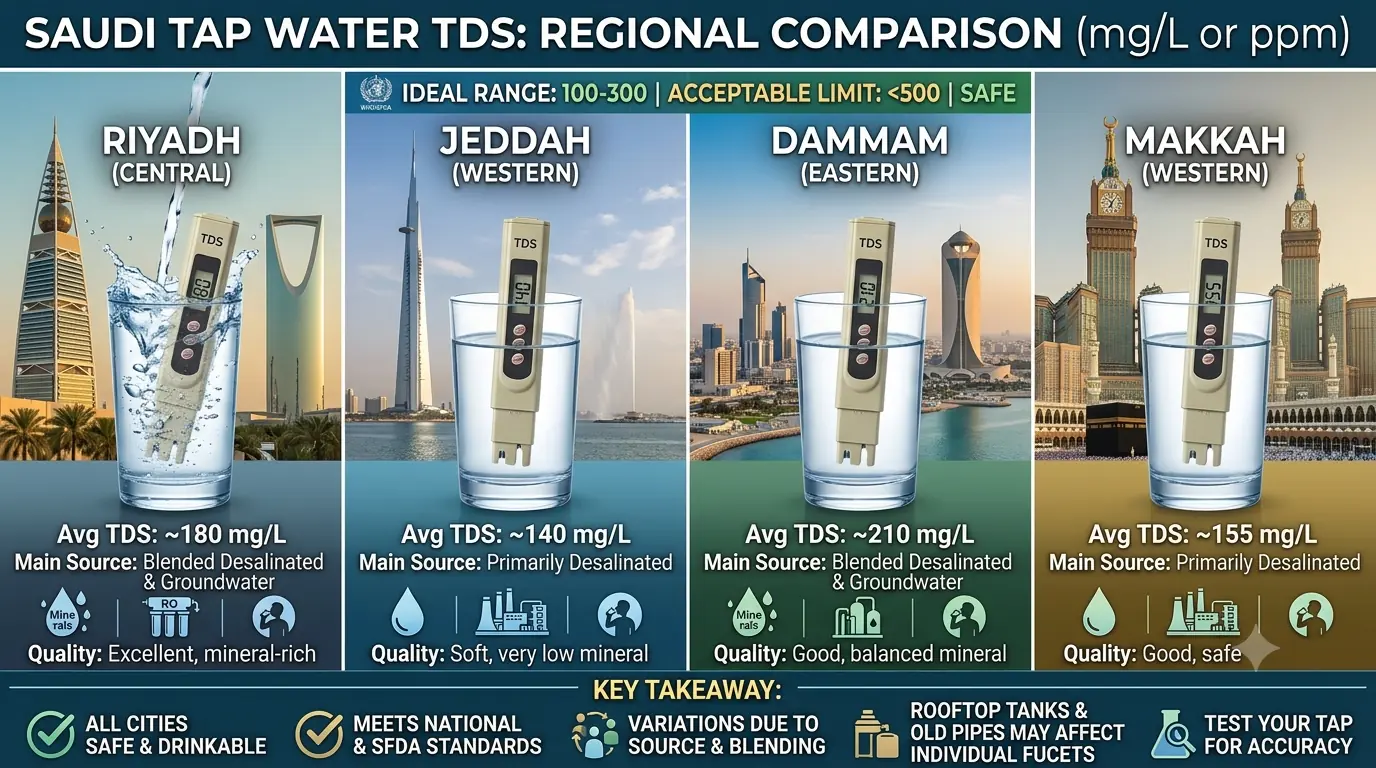
For context: the WHO does not set a strict TDS limit but considers water above 1,000 mg/L unacceptable and notes palatability issues above 600 mg/L. For optimal taste and health, TDS of drinking water should ideally be between 100 and 300 ppm.

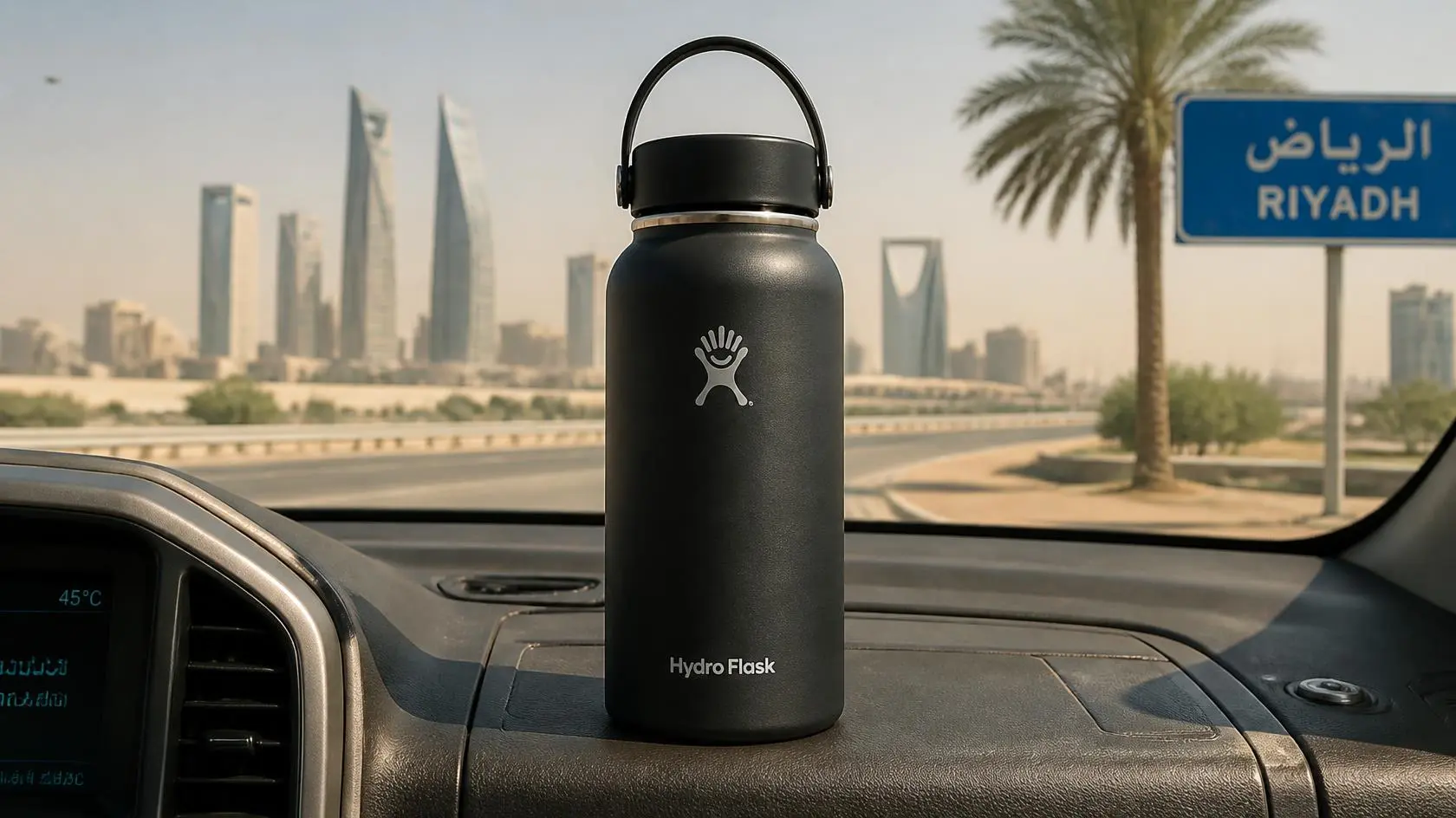
Saudi tap water is not groundwater from a local aquifer. Riyadh is supplied with desalinated water pumped from the Persian Gulf over 467 kilometres to the city in the heart of the country. By the time that water reaches your tap, it has travelled through hundreds of kilometres of pipeline, sat in a rooftop storage tank baking in 45°C heat, and picked up sediment and heavy metal traces from your building’s internal plumbing. That journey is why the number on your TDS meter is so much higher than it was at the desalination plant’s output — and why it varies so much between cities.
TDS by Saudi city — what the research actually shows
Almost all municipal water in Saudi Arabia originates at desalination facilities operated by the Saline Water Conversion Corporation (SWCC). Water quality monitoring data confirms that groundwater fed into Riyadh from dams showed hardness values in the range of 197 to 281 ppm at source — before building storage tanks and internal pipes add their own contribution.
Here is what available data, combined with on-the-ground expat testing, shows across the major cities.
| City | Primary Water Source | Typical Tap TDS Range | Classification | Main Problem |
|---|---|---|---|---|
| Riyadh | Desalinated Gulf water + groundwater blend | 350 – 550 ppm | Hard to very hard | High chlorine, heavy sediment from rooftop tanks |
| Jeddah | Red Sea desalination plants | 200 – 400 ppm | Moderately hard | Variable chlorine, aging distribution pipes |
| Dammam / Al Khobar | Gulf desalination (Khobar RO plant) | 300 – 500 ppm | Hard | High mineral load from RO source water |
| Makkah | Shoaibah desalination pipeline | 250 – 450 ppm | Hard | Seasonal variation, high calcium |
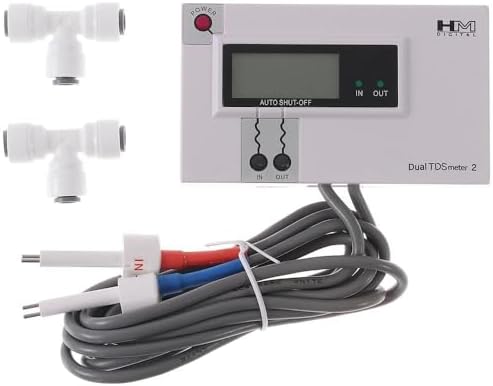
Important caveat: These are ranges, not fixed numbers. Your actual tap reading will depend on your specific building’s storage tank condition, the age of your internal pipes, your floor level, and the season. Summer readings are consistently higher than winter readings across all cities because heat concentrates dissolved solids in rooftop tanks. A TDS meter costs SAR 70 to 250 on Amazon.
Why Riyadh consistently reads highest
Riyadh’s water problem is unique because of geography. The 467-kilometre pipeline distance from the Gulf means water must be heavily dosed with chlorine to remain safe across the entire journey. By the time it reaches a residential building in Al Rawdah, Olaya, or Malaz, it has been in the pipe system for days.
Groundwater and dam sources also fed into Riyadh show hardness values that exceed SWCC guidelines for total hardness. This groundwater is blended with the desalinated supply before distribution, which means Riyadh tap water is a mixture of two already-hard sources. The rooftop tank then sits in full sun for months, evaporating water content and concentrating the dissolved solids further before it ever reaches your showerhead.
My 480 ppm reading from Al Rawdah is consistent with what other Riyadh expats report. Residents in Olaya report 420 to 500 ppm; residents near the southern ring road report up to 560 ppm. The variation is real and building-specific.
Why Jeddah reads lower — but is still a problem
Jeddah is built on the Red Sea coast, which means its desalination plants draw from a different and marginally less saline source than the Gulf water used for Riyadh. The city’s relative proximity to its water source also means less transit time and therefore lower chlorine dosing requirements. Some older plants like Jeddah RO1 and RO2 were decommissioned as part of SWCC’s infrastructure renewal programme.
That said, lower TDS does not mean Jeddah water is gentle. Expats in older Jeddah neighbourhoods regularly report heavy scale buildup and the same hair and skin issues as Riyadh residents — the infrastructure in parts of the city is significantly older, and corroding distribution pipes contribute their own mineral load regardless of what the desalination plant produces.
Dammam and Al Khobar — the Eastern Province situation
The Khobar RO plant has consistently produced water with TDS values in excess of SWCC recommended levels. The Eastern Province sits on the Gulf coast, which has the highest natural salinity of any water body Saudi Arabia draws from. Even after desalination, the residual mineral content tends to be higher than Red Sea-sourced water.
Expats in Dammam and Al Khobar also report faster scale buildup in appliances and more noticeable pressure drops in shower filters — consistent with higher sediment loads than Jeddah.
Makkah — seasonal variation and pilgrimage pressure
Makkah presents a different challenge. The Shoaibah pipeline that supplies the city was designed for a resident population, but the city’s water demand spikes massively during Hajj and Umrah seasons. During peak demand, TDS values in the network can rise above SWCC recommended thresholds. Rooftop tanks in older buildings — particularly in the rings around the Haram — often read significantly higher due to age and infrequent cleaning.
If you are an expat working in Makkah’s hospitality or construction sectors, expect seasonal variation in your tap readings and plan your filter replacement schedule accordingly.
What your TDS reading actually means for you
Here is the practical translation of the numbers:
| Your TDS Reading | What It Means | What You Need |
|---|---|---|
| Below 150 ppm | Clean, low mineral water | Basic carbon filter sufficient |
| 150 – 300 ppm | Moderately hard | Good shower filter, optional RO for drinking |
| 300 – 500 ppm | Hard — scale buildup, hair and skin impact | Shower filter essential, RO strongly recommended |
| Above 500 ppm | Very hard — aggressive damage to appliances and hair | Shower filter + RO filter, check rooftop tank |
My 480 ppm reading puts Al Rawdah squarely in the “RO strongly recommended” category for drinking and “shower filter essential” category for bathing. Both are separate problems requiring separate solutions — a shower filter does not make your drinking water safer, and an RO unit does not protect your hair and skin in the shower.
The two fixes every Saudi apartment needs
For your shower: A KDF-55 shower filter neutralises chlorine and traps heavy metals. It does not significantly reduce TDS but removes the chemicals doing the most damage to your hair and skin. I tested three units over four months — read my full shower filter review for Riyadh hard water to see exactly which one survived the Saudi sediment load and which ones failed.
For your drinking water: An under-sink Reverse Osmosis system is the only residential technology that genuinely strips dissolved solids. Carbon filters and UV systems address specific contaminant types but do not reduce dissolved solids. My full RO filter guide for Saudi Arabia covers what is available on Amazon.sa, what to expect from installation in a rented apartment, and what your post-filter TDS reading should look like.

- ACCURATE AND RELIABLE: To achieve high accuracy, equipped with premium quality titanium alloy probe, and reliable Automa…
- MULTIFUNCTIONAL AND UPGRADED: Professional TDS, EC and Temperature Pen 3 in 1. Upgraded with big backlit LCD for easier …
- EASY AND INSTANTLY: Just turn TDS meter on and stir water gently, then stabilized readings will be auto-locked on LCD in…
How to test your own tap — the SAR 20 solution
Everything in this post is a range. Your building is specific. Your neighbourhood is specific. Your rooftop tank’s last cleaning date depends entirely on your landlord’s level of conscientiousness.
A basic TDS pen meter costs SAR 15 to 25 on Amazon.sa. Test your kitchen tap, your bathroom tap, and — if you can access it — the tank outlet on your roof. Test in the morning before heavy usage and again in the evening. Write the numbers down with the date. Retest every two months. The change over time tells you more than any single reading.
👉 TDS Meter on Amazon.sa

- Measure TDS & Temperature
- Water Resistant Housing
- Magnetic Body
Frequently asked questions
Tap water in major Saudi cities is treated to potable standards, but local plumbing, taste, and intermittent supply issues make bottled or filtered water the pragmatic choice — especially for vulnerable people and those in older properties. Most long-term expats use a filter or bottled water for drinking regardless of the technical safety status.
Morning readings after overnight tank standing tend to be higher because dissolved solids concentrate as water sits without flow. Evening readings after a day of household usage tend to reflect fresher supply from the mains. Test both and use the average.
No — it makes it worse. Boiling evaporates water while the dissolved solids remain, concentrating them in a smaller volume. Boiling kills bacteria but has no effect on dissolved minerals, salts, or chlorine compounds.
Different cities, different water sources, different pipeline distances, different building ages. Riyadh’s water travels the furthest from the coast, is blended with harder groundwater, and sits longest in rooftop tanks. Jeddah’s Red Sea supply and shorter distribution network produce consistently lower readings
Test both if you can safely access the tank outlet. The difference between tank output and tap output tells you how much your building’s internal pipes are contributing to the TDS load. A big gap between the two numbers points to pipe corrosion as a secondary problem.