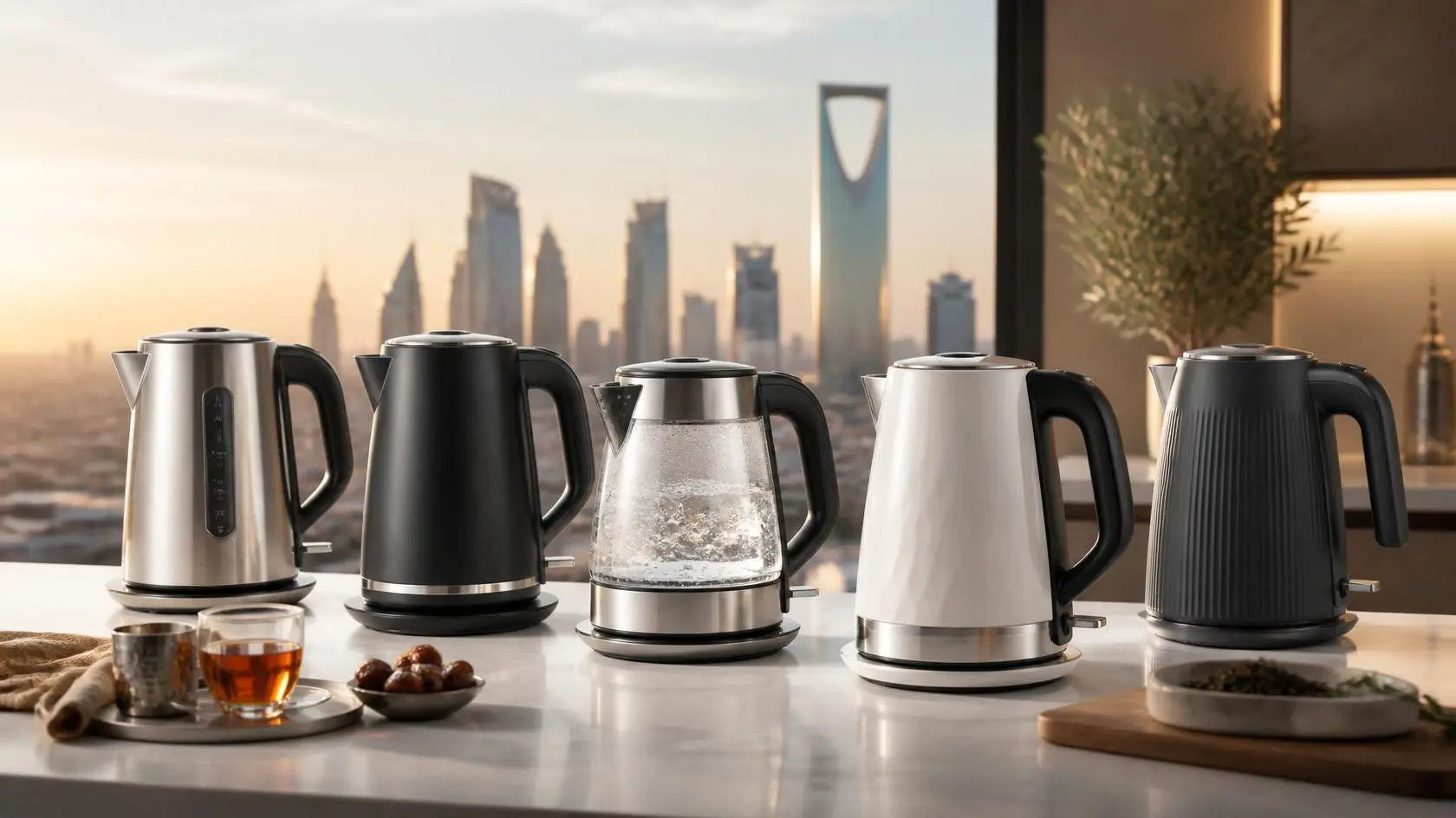
This post contains affiliate links — read our disclosure. As an Amazon.sa associate, I earn from qualifying purchases.
If you have already read my post on why Saudi kettles die in 6 months, you already know the problem. Riyadh tap water reads around 480 ppm. That concentrated calcium and magnesium destroys a standard kettle element in months — not years. The white crust you see inside is not cosmetic; it is a slow element killer.
I have been through three kettles since moving to Al Rawdah. The fourth one is still alive — and that is the model I am going to recommend here. But the honest answer is that the brand matters less than the material the kettle is made from, the filter design, and whether you can actually descale it without destroying it.
Here is what I found after testing four models on Riyadh’s hard water.
Why Saudi Arabia Needs a Different Kettle Standard
Most kettle reviews are written by people whose tap water reads 100 to 200 ppm. In London, Paris, or Toronto, a budget kettle lasts three to four years without a single descale. In Riyadh, that same kettle fails in four to six months.
The reason comes down to rooftop tank concentration. By the time water has sat in a fiberglass tank baking in 45°C summer heat and passed through aging building pipes, the dissolved calcium and magnesium load is extreme. Every boil deposits more scale. Every deposit insulates the element further. Eventually, the element overheats and fails completely.
What this means practically: you need a kettle specifically designed to handle high-mineral water. That means:
- Stainless steel interior only
- A removable and washable filter
- A wide top opening so you can get your hand inside for manual descaling
What I Tested — Four Kettles on Riyadh Tap Water
Test Conditions: 480 ppm tap water, daily use (2 to 3 boils per day), unfiltered building water supply in an Al Rawdah apartment.
Testing Period: January to August 2026.
Descaling Method: Citric acid powder (1 tablespoon per 500 ml of total water, monthly).
Assessment Criteria: Element lifespan, descaling ease, spout filter performance, build quality, and whether the interior actually comes clean after a citric acid treatment.
The Four Models Compared
1. Tefal Express Electric Kettle — SAR 105 (Top Pick)

- Model Number: N/A
- Type: Electric Kettle
- Capacity: 1.7 Liter
This is the model I currently use and recommend for most Riyadh expats. Tefal designed this model with a 360-degree removable filter that soaks clean in citric acid in about 20 minutes. The stainless steel interior descales completely, leaving no brown mineral staining. The element is recessed under a stainless steel plate, meaning scale deposits on the plate rather than directly on an exposed coil, significantly extending element lifespan.
After seven months of daily use in my apartment, the element is still working at full speed. The filter has been soaked twice, and the interior is spotless. This is the first kettle I have owned in Riyadh that does not feel like it is struggling.
What I don’t like: The lid mechanism requires two hands to open comfortably — a minor inconvenience when filling it one-handed at the tap.
2. Philips Daily Collection Kettle — SAR 90 (Runner-Up / Budget Option)

- Easy to read water level indicator for trouble-free use
- Cordless pirouette base for easy lifting and placing
- Pilot light indicates when the kettle is working
The most common kettle in Saudi apartment buildings — available at almost every Danube, Tamimi, and Extra store. The interior is stainless steel and handles hard water reasonably well for the first three months. After that, the spout filter begins clogging, and the pressure from the heating element against accumulated scale becomes noticeable in slower boil times.
At SAR 89, it is genuinely affordable. If you are on a short lease, it will likely survive long enough. For anyone staying longer than six months, the Tefal is well worth the extra SAR 56.
What I don’t like: The filter is only partially removable — you can rinse it, but you cannot remove it completely to soak separately. This makes deep descaling difficult and leaves scale residue around the filter edges.
3. Russell Hobbs Glass Kettle — SAR 450 (Avoid)
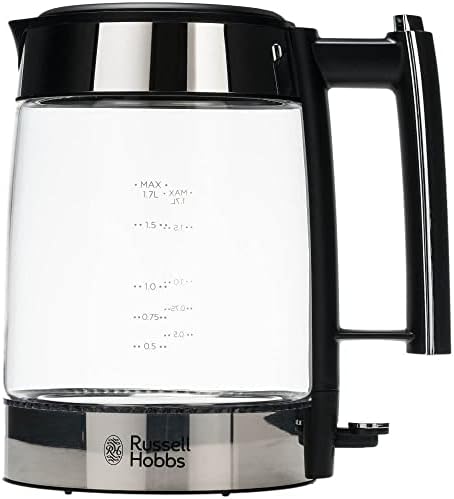
- Eye-catching kettle with high quality glass design and blue lighting when boiling
- 1.7 liter capacity and 2200 watts of power
- Snap open lid for easy opening
It looks beautiful on the counter with its illuminated blue LED. However, glass and Saudi hard water are a deeply incompatible combination. Within six weeks of daily use, the interior walls had a visible white film that did not fully clear even after two citric acid treatments. After three months, the glass had a faint cloudy etching that became permanent.
Russell Hobbs is not at fault here — their product works well in soft water markets. However, high-TDS Saudi tap water etches glass over time, and no cleaning method reverses it. Avoid glass kettles entirely in Riyadh apartments, regardless of the brand.
Verdict: Do not buy for Saudi use.
4. Generic Amazon.sa Stainless Kettle (SAR 50–90) (Emergency Only)
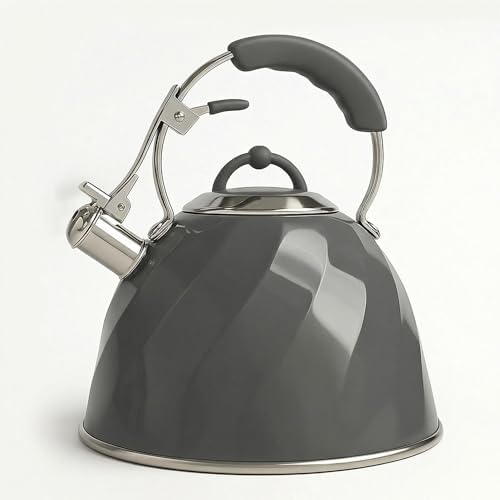
- 1. Premium 201 Stainless Steel Construction Made from high-quality 201 stainless steel, this kettle is durable, rust-res…
- 2. 5L Large Capacity for Family Use With a generous 5-liter capacity, this whistling kettle is perfect for families, gat…
- 3. Loud Whistling Alert for Safety Equipped with a loud whistle, the kettle automatically alerts you when water reaches …
Available from multiple unbranded sellers. I bought one as a backup when my second kettle failed and I was waiting for a delivery. The interior is described as stainless steel, but the alloy and finish are noticeably thin. After eight weeks of hard water use, the base had visible brown residue that citric acid could not fully clear. The spout filter clogged completely by week ten.
At SAR 40–60, it is tempting. But under Riyadh conditions, it is a two-month kettle. You will spend SAR 300+ a year replacing them continuously.
Verdict: Emergency purchase only.
Side-by-Side Comparison
| Model | Price (SAR) | Interior | Filter Design | Descales Cleanly? | Expected Riyadh Lifespan | Best For |
|---|---|---|---|---|---|---|
| Tefal Express | SAR 105 | Stainless steel | Removable & soakable | ✓ Yes — completely | 12+ months | Most expats — best overall |
| Philips Daily | SAR 90 | Stainless steel | Partial removal only | ⚠️ Mostly | 5–7 months | Short-lease expats |
| Russell Hobbs Glass | SAR 450 | Glass | Fixed | ✗ Glass etches permanently | 2–3 months | Avoid in Saudi Arabia |
| Generic Stainless | SAR 50–90 | Thin stainless | Fixed | ✗ Brown staining remains | 2 months | Emergency purchase only |
The One Change That Extends Any Kettle’s Life
Buy the kettle first. Then buy a TDS meter for SAR 20 on Amazon.sa. Start filling your kettle from your RO filter output tap rather than directly from the main building supply.
An under-sink RO tap outputs around 10 to 40 ppm — compared to 480 ppm from the building tap. At 10–40 ppm, limescale formation is practically zero. The Tefal kettle I am using would have failed long ago if I had kept filling it from the tap. Because I switched to RO-filtered water in month three, the element is still running like new in month seven.
Key takeaway: The kettle alone is only half the battle. A good kettle + RO filtered water is the permanent fix.
If you do not have an RO filter yet, my under-sink RO filter guide for Saudi Arabia covers which models actually survive Riyadh’s water conditions and how installation works in a rented apartment.
How to Descale Properly in Saudi Arabia
Standard manufacturer instructions tell you to descale every three to six months. In Riyadh, you need to descale every four to six weeks.
Method 1: Citric Acid Powder (Recommended)
- Dissolve 1 tablespoon of citric acid powder in 1 cup of hot water.
- Pour into the kettle and fill to the halfway mark with cold tap water (total volume approximately 500 ml).
- Bring to a single boil, then turn off and let it soak for 45 minutes.
- Empty the kettle and run two full boil-and-discard cycles with fresh water before making tea or coffee.
Note: Citric acid leaves zero smell or taste and is sold cheaply in the baking aisle at Danube, Tamimi, and LuLu.
Method 2: White Vinegar (Backup Option)
- Mix equal parts white vinegar and tap water to fill the kettle halfway.
- Bring to a boil, then turn off and soak for 60 minutes.
- Empty and run two to three full boil-and-discard cycles with fresh water.
Note: Vinegar works well, but requires extra rinsing to eliminate the lingering sour odour.
❌ What NOT to Use
Avoid commercial descaling tablets designed for espresso machines. Many contain aggressive sulfamic or phosphonic acids that can degrade internal rubber seals on basic electric kettles over time.
Where to Buy in Saudi Arabia
- Amazon.sa (Recommended): Fast Prime delivery, reliable return policies, and direct imports.
- Extra: Good stock of Tefal and Philips. Tip: Double-check model numbers in-store vs. online, as physical stores sometimes sell older revisions at full price.
- Danube / Tamimi: Convenient for picking up the budget Philips Daily collection and citric acid powder.
- Third-Party Sellers: Be cautious with unknown third-party sellers on marketplace sites offering “unbranded stainless steel” at deep discounts. Low-grade steel corrodes rapidly in high-TDS water.
Frequently Asked Questions
Tefal is currently the most reliable brand due to its recessed element design and fully removable filters. Philips is a solid second choice for budget-conscious buyers on short-term leases.
Every 4 to 6 weeks when filling directly from the tap. If you use RO-filtered water (10–40 ppm), you only need to descale once every 3 to 4 months.
You can, but it is not recommended. Zamzam water has a rich mineral profile that will deposit scale on the heating element just like tap water does. It is best enjoyed fresh for drinking rather than used for daily hot beverages.
A metallic smell after descaling occurs when dissolved mineral residue or descaling acid remains on the heating element. Run two additional boil-and-discard cycles with fresh tap water to clear it completely.
Only if it features a high-grade stainless steel interior and a removable, washable filter. A SAR 300 kettle with a fixed filter or glass body will fail just as quickly as a SAR 60 model in 480 ppm water.
Yes. Saudi Arabia operates on a 220V–240V / 60Hz electrical system. Kettles bought locally or from Amazon.sa are compliant. Avoid importing 110V kettles from North America, as plugging them into Saudi outlets will instantly blow the internal heating element or fuse.
Final Recommendation
If you live in Riyadh or anywhere with hard tap water in Saudi Arabia, buy the Tefal Express (SAR 145). It costs slightly more than entry-level kettles, but over 12 months, that small premium saves you from repeatedly replacing dead appliances.
- Avoid: Glass kettles (permanent mineral etching).
- Emergency Only: Unbranded SAR 40–60 stainless kettles (thin metals corrode fast).
- Pro Tip: Fill your kettle using your under-sink RO tap, descale monthly with citric acid, and it will last for years.
For more on why Saudi hard water destroys appliances and how to protect your apartment, check out my full breakdown on Why Your Saudi Kettle Dies in 6 Months and my guide to the Best Shower Filters for Riyadh Hard Water.


Leave a Reply