Ask a group of drivers in Riyadh whether a dash cam is legal here and you will get three different answers: one says it is banned, one says the police require it, and one has already installed two. The confusion is understandable. Saudi Arabia has strict privacy laws, and people hear about heavy fines for filming — so they assume the camera itself must be the problem.
It is not. The camera is fine. What can get you into serious trouble is what you do with the footage. This guide explains, in plain language, what Saudi law actually says about dash cams: when recording is allowed, when your footage helps you, and the one mistake — posting clips online — that turns a safety device into a legal risk.
Quick note: this is general information based on published Saudi law and official statements, not legal advice. For a specific case, consult a licensed Saudi lawyer.
The short answer
Yes, dash cams are legal in Saudi Arabia. There is no ban on owning or installing one, and no permit is required. Saudi lawyers have confirmed this publicly: a dash cam is treated like any other camera, and its footage can be used as evidence — the insurance services company Najm itself asks for dash cam footage when handling road accident reports.
The legal risk sits in two places only:
- Invading someone’s privacy with a camera — covered by Article 3 of the Anti-Cyber Crime Law.
- Publishing footage that defames or shames someone — the same article, plus repeated warnings from the Ministry of Interior.
Record your driving, protect yourself after an accident, and you are on solid ground. Upload someone’s worst moment to social media, and you are not.
Why so many Saudi drivers are installing dash cams
Dash cam sales in the Kingdom have grown quickly, and the reason is practical, not fashionable. On Saudi roads, the argument after a minor accident is usually about who changed lanes, who braked, and who was actually at fault. A clear video ends that argument in seconds.
That is exactly why the footage matters to the authorities and insurers. When Najm attends an accident scene or processes a report, video evidence helps establish liability far faster than two conflicting stories. Saudi lawyer Khalid Al-Mhmadai explained the position plainly in remarks reported by Arab News: dash cams are allowed, the footage counts as evidence, and it can be used in legal proceedings as long as the picture is clear and it was recorded in a public place — which a public road is.
There is a second reason drivers here want cameras: the heat. Electronics fail fast in a Saudi summer, which is why the type of dash cam matters as much as having one. If you are still choosing a camera, our guide to heat-resistant dash cams for Saudi Arabia explains why supercapacitor models survive summers that kill battery-based ones.
The law that actually matters: Anti-Cyber Crime Law, Article 3
There is no “dash cam law” in Saudi Arabia. Dash cams fall under the general rules about cameras and privacy, mainly the Anti-Cyber Crime Law of 2007. Article 3 lists offences punishable by imprisonment for up to one year, a fine of up to SAR 500,000, or both. Two items on that list are the ones every driver should know:
| Article 3 offence | What it means for a driver |
|---|---|
| Invasion of privacy through the misuse of camera-equipped mobile phones “and the like” | Filming people in situations where they have a reasonable expectation of privacy — the dash cam is a camera “and the like”, so where and how you point it matters |
| Defamation and inflicting damage on others through IT devices | Posting a clip to shame, mock or damage someone — even if everything in the clip really happened |
The Saudi Public Prosecution repeats this warning regularly: defaming or harming others through technology is a cybercrime, and the Article 3 penalties apply to it. Notice what the law does not say. It does not punish recording your own journey on a public road. It punishes using recordings to invade privacy or to harm someone’s reputation. That distinction is the whole game.
The real danger: posting the clip online
This is where most drivers get it wrong. Your dash cam records a dangerous driver, a road-rage incident, or even a crime. Your first instinct is to post it so “something gets done”. In Saudi Arabia, that instinct can make you the offender.
In February 2024, the Ministry of Interior’s security spokesman, Col. Talal Al-Shalhoub, warned the public in clear terms: photographing a crime and publishing it is itself a violation of the Anti-Cyber Crime Law — in his words, do not treat a crime with a crime. His instructions were specific:
- Documentation of an incident should be handed to the security authorities, not posted in the public domain.
- Report incidents to the Security Operations Center on 911.
- Publishing footage can amount to defamation, which carries the Article 3 penalties above — on top of any other law the act falls under.
The same principle appears in the Law of Security Surveillance Cameras: transferring or publishing surveillance recordings is prohibited, and the Ministry of Interior confirmed in January 2025 that violators face a fine of SAR 20,000. That law governs surveillance camera systems rather than car dash cams, but it shows the direction of Saudi law as a whole: recordings are evidence for the authorities, not content for the public.
So the rule is simple. If your camera catches something serious, you have two safe options: give the footage to the police or Najm, or keep it for your own claim. Social media is not the third option.
How to use a dash cam the safe way
Staying legal is mostly common sense once you know where the lines are.
Mount it where it does not block your view. The standard position — high on the windshield, behind or beside the rear-view mirror — keeps the camera out of your sightline and gives it the clearest view of the road. A camera dangling in the middle of the windshield is a hazard whatever the law says.
Point it at the road, not at people. A front camera recording traffic is doing its job. Deliberately filming inside someone else’s car, or following and recording a specific person, moves you toward the privacy offence in Article 3.
Be careful near security-sensitive places. Slow down your assumptions around checkpoints, military facilities, and government security sites. Filming security installations is restricted in Saudi Arabia; if you are stopped and asked about the camera, cooperate and explain it is a driving recorder. Most officers know dash cams well — they deal with the footage daily.
Tell your passengers if the cabin is recorded. Many dual-channel cameras record the interior and audio. If you drive for a ride-hailing platform or regularly carry colleagues, tell them the camera records inside the car, and never publish cabin footage of passengers. Their privacy rights are exactly what Article 3 protects.
Do not live-stream your driving. Streaming apps add publication to recording — the one combination this guide keeps warning about. Record locally to the memory card; review later if something happens.
While you are setting up the camera, it is worth sorting the rest of the car’s heat kit too: a portable jump starter that survives Saudi heat and a proper windshield sun shade solve the two other problems the summer causes.
After an accident: using your footage the right way
This is the moment the dash cam earns its money, and there is a right way to handle the footage:
- Keep the original file untouched. Do not trim, filter, re-encode or “enhance” the clip you hand over. An edited video invites the argument that it was tampered with; the raw file from the card is your strongest evidence.
- Back it up before it is overwritten. Dash cams record in a loop. Copy the incident clip to your phone or computer the same day, before the card cycles over it.
- Give it to Najm and the traffic police. Share the footage through the official report process. This is the channel the Ministry of Interior itself points people to, and it is where the video actually changes the outcome — liability, claims, and fault decisions.
- Report serious incidents on 911. If the footage shows a crime or a hit-and-run, report it and offer the recording to the authorities.
- Do not post it — even to “warn others”. Not with the plates blurred, not with the faces covered, not after the case is closed. Posting is the act the law punishes; the verdict does not make it safe.
And once the paperwork is done, the inside of the car usually needs attention too — sand and accident debris get everywhere, which is why we keep a handheld car vacuum in the boot.
Practical tips summary
The camera is legal: No ban, no permit — dash cams are allowed in Saudi Arabia, and lawyers confirm the footage works as evidence.
Najm is your audience: Accident footage belongs with Najm and the traffic police, where it settles fault and speeds up claims.
Article 3 is the line: Privacy invasion and defamation through recordings can bring up to one year in prison and a fine of up to SAR 500,000.
Never post incident clips: The Ministry of Interior treats publishing crime footage as a cybercrime — report on 911 and hand the video to the authorities instead.
Mount it smart: Behind the rear-view mirror, aimed at the road, never blocking your view of traffic.
Keep originals raw: Back up the unedited file the same day, before loop recording overwrites it.
Three dash cams that survive Saudi heat
Knowing the rules is half of it — the other half is a camera that still works in August. These three are the proven picks from our full testing guide, all supercapacitor models with the affiliate links below.
VIOFO A129 Pro Duo (4K Front + 1080p Rear)
Our top pick — 4K front and rear recording on a supercapacitor built for desert heat.

- 【Ultra HD Real 4K Dual Channel Dash Cam】 Adopt top quality Sony 8MP IMX317 Sensor on front camera and Sony IMX 291 senso…
- 【Upgraded Super Night Vision & WDR】Come with 8 Megapixel image sensor, provide a much clearer image than most dash camer…
- 【Buffered Parking Mode】Buffered parking mode will be able to record events leading up to an impact / motion that has bee…
Vantrue N5 (4-Channel Dash Cam)
The 360-degree one — four channels covering front, rear and cabin, with STARVIS 2 night vision.
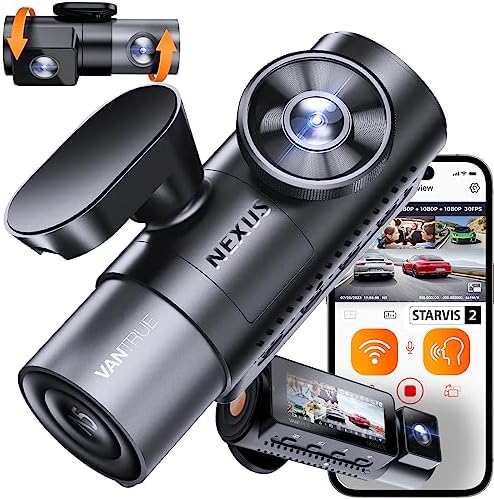
- 【The first 4-channel dash cam】The N5 features 2-megapixel super-sensitive sensors that record the front, rear, front cab…
- 【Stavis 2 Infrared Night Vision with】Thanks to the front and front cabin cameras’ STARVIS 2 advanced IMX 675 sensor and …
- 【Inbuilt WiFi & GPS Speed】The inbuilt 2.4GHz/5GHz Wi-Fi brings faster transfer speed, and allows you directly to live vi…
KINGSLIM Dash Cam Front and Rear (2K + 1080P)
The budget one — 2K front, 1080p rear and WiFi, without the premium price.

- 2K + 1080P DUAL CHANNEL DASH CAMERA : E2PRO front and rear dashcam simultaneously capture 1440P 2k front facing videos a…
- SMART WiFi-APP CONTROL : Built in wireless WiFi connection function, KINGSLIM APP for Android or iOS smartphones to get …
- MINI COMPACT & HEAT RESISTANCE DESIGN : 1.47 inch LCD screen, mini and lightweight camera body design, this car camera w…
Yes. Dash cams are legal to own and install in Saudi Arabia, and no permit is required. Saudi lawyers have confirmed that dash cam footage is accepted as evidence, including by Najm when it handles accident reports, provided the recording is clear and was made in a public place.
Yes. Footage from your dash cam can support a Najm report, an insurance claim, and legal proceedings. Keep the original, unedited file — edited clips are easier for the other side to challenge — and submit it through the official report process.
This is the risky part. Posting footage to shame or defame someone falls under Article 3 of the Anti-Cyber Crime Law — up to one year in prison and a fine of up to SAR 500,000. The Ministry of Interior has specifically warned that publishing recordings of crimes is itself a cybercrime; evidence should go to the authorities or be reported on 911 instead.
Where the sharing invades privacy or defames the person, Article 3 of the Anti-Cyber Crime Law sets a fine of up to SAR 500,000, imprisonment of up to one year, or both. Separately, publishing security surveillance camera recordings carries a SAR 20,000 fine under the surveillance cameras law.
A camera recording the road is unproblematic. An interior camera that records passengers and audio touches their privacy rights, so drivers should inform passengers that recording is in place and must never publish cabin footage. Platform rules may add their own requirements on top of the law.
There is no permit or registration requirement for a normal front-facing dash cam. Telling passengers is a courtesy that becomes important only when the camera records the cabin or audio — and at security checkpoints, simply cooperating and explaining the device is a driving recorder is the sensible approach.
Researched October 2026 from published Saudi law (Anti-Cyber Crime Law, Article 3), Ministry of Interior statements, and Saudi legal commentary. General information only — not legal advice.