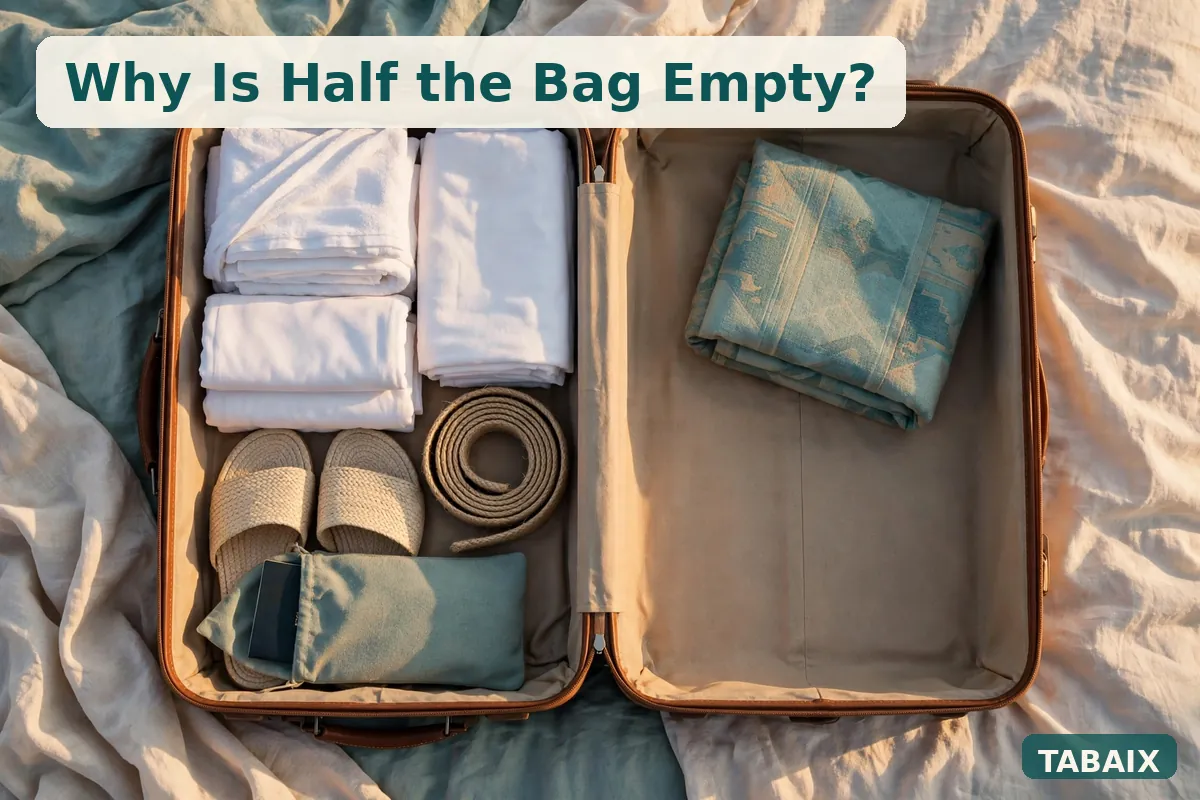
Every Umrah traveller makes the same mistake: half the bag gets filled with things that are sold on every street in Makkah, and the one item that would cost half a day — and half your concentration in worship — to track down over there is the one left behind. This checklist is the answer to that problem: what to pack from home, what to buy easily after you arrive in Saudi Arabia, and what not to take at all.
This guide is written for first-time and repeat Umrah travellers — families coming from Pakistan and India, and expats travelling from inside Saudi Arabia. It follows the same order you will actually pack in: documents first, then Ihram and clothes, footwear, health, money and phone, and finally the packing method itself. At the end there is a clean copy-paste checklist you can tick off item by item.
Affiliate disclosure: Some links in this post are affiliate links. If you buy through them, Tabaix may earn a small commission at no extra cost to you. It never changes what we recommend — we only list things a pilgrim genuinely needs.
Documents First: Visa, Nusuk and the Vaccine Paperwork
Pack your papers before your clothes, because clothes can be bought there — documents cannot be replaced there.
Passport and visa. Your passport should be valid for at least six months beyond your travel date — this is a standard Saudi entry requirement, so check the expiry date the day you book, not the day you fly. Keep your Umrah visa (or the visa you are travelling on) printed as well as saved on your phone. Airlines and hotels still ask for paper more often than you would expect.
Nusuk app. The Nusuk app is the Saudi Ministry of Hajj and Umrah’s official platform, and it is not optional decoration — your Umrah permit and your Rawdah (Riyad al-Jannah) prayer permit in Madinah are booked through it. Install it, register, and book your slots before you travel. Rawdah slots in particular fill up fast, so the family member who is “good with phones” should do this for everyone in the group, with screenshots saved in case the signal inside the Prophet’s Mosque is weak — which it often is.
Vaccine certificate — the one that is missed most often. Under the Saudi Ministry of Health’s health requirements for Umrah travellers, the meningococcal (meningitis) ACWY vaccine is required, and it must be taken at least 10 days before you arrive in Saudi Arabia. The conjugate vaccine stays valid for five years and the polysaccharide type for three years (the newer pentavalent ACYWX conjugate is also accepted, with the same five-year validity), and you should carry the vaccination certificate with your passport. One detail on that certificate: it must state the vaccine type and the date — if the type is not written on it, the certificate is treated as valid for three years only. Do not leave this for the last week — a vaccine taken three days before your flight does not meet the 10-day rule. Travellers arriving from Pakistan should also make sure their polio vaccination is documented, as the same health requirements ask arrivals from Pakistan and Afghanistan for proof of at least one polio dose (bOPV or IPV) — and the MOH guidance is that the dose should be within the previous 12 months and at least 4 weeks before arrival, so an old childhood record alone may not be enough. One more requirement families often miss: travellers in high-risk groups — over 65, pregnant women, and people with chronic heart, respiratory or kidney conditions, cancer, or weakened immunity — must also carry proof of COVID-19 vaccination or immunity (one dose of the updated 2025–2026 vaccine, a completed primary series from 2021–2024, or a lab-confirmed recovery during 2025). If you are taking elderly parents, check this for them before you book. If you are coming from a yellow-fever-affected country, that certificate is required too. Requirements can change between seasons, so confirm the current list on the Saudi Ministry of Health website before you fly — but the meningitis rule has been in place for years, so get it done early and keep the card safe.
Paper folder + phone folder. Make one slim document pouch that never leaves your hand luggage: passport, visa printout, vaccine certificate, hotel confirmations, flight details, and one photocopy set of everything. Then make the same set digital: photos or PDFs in your phone, and one copy sent to a family member’s phone or your own email. If a bag is lost, the digital copy is what saves your day.
One more document habit: photograph the luggage tag and your hotel’s name card in Arabic as soon as you check in. If you ever need a taxi driver to take you back, that photo is worth more than your memory of the street name.
Ihram and Clothing: A Light Bag, the Right Things
Men’s Ihram. The Ihram is two unstitched white cloths — one wrapped around the waist, one over the shoulders. While in the state of Ihram, men do not wear stitched garments (no underwear, no vest, no stitched cap), do not cover the head, and do not use perfume or scented products. Buy your Ihram set at home if you already know your size and the fabric you like, because you will usually put it on either at home, at the airport, or at the Miqat — three places where you do not want to be experimenting with an unfamiliar cloth. A thicker cotton Ihram is more forgiving for first-timers; the very thin ones slip constantly.
Two small items make Ihram life much easier. The first is an Ihram belt — a simple strap belt worn over the lower cloth that keeps it from slipping during Tawaf and holds a little cash. It is worn by pilgrims everywhere and solves the single most annoying Ihram problem.

The second is a small neck pouch for your phone, permit screenshots’ printout and some cash, worn under or over the shoulder cloth. In the crowds around the Kaaba, pockets do not exist and hands are busy — a pouch is the difference between calm and panic.

- [RFID Blocking] The travel neck pouch uses RFID blocking technology to protect your important personal information from …
- [Spacious and Organized] This waterproof passport holder features multiple compartments and pockets to easily store your…
- [Waterproof & Durable] This travel neck wallet is made of waterproof material to protect your belongings from sweat, rai…
If you still need an Ihram set itself, buy one good cotton set before travel rather than three cheap ones.

- Premium Material: This ihram clothing for men is made of 100% high quality polyester, soft and skin-friendly, lightweigh…
- Size: 210x110cm/82″x43″, this ihram clothing for men hajj can conveniently fit most body types; easy to take off or wear…
- Fine Design: Our men Ihram towels are not sewn and meet Hajj and umrah ritual requirements for ihram.
Women’s clothing. Women wear their normal modest dress and abaya for Umrah; there is no special Ihram garment, but while in Ihram the face veil (niqab) and gloves are not worn, so many women carry a loose cap-style hijab or a hat-like shade that does not touch the face. Pack two abayas at most — one on you, one spare. Abayas are sold everywhere in Makkah and Madinah in every size and budget, and this is one item where buying there is genuinely better: the fabric suits the climate and the prices are competitive.
Everyday clothes. Count your days, then subtract. Most pilgrims spend their days in the Haram and do laundry once during a week-long trip — hotels and nearby laundries both do it. Three to four sets of light, loose clothing is enough for most people. Cotton and cotton blends beat synthetics in the heat. Pack one warm layer no matter what month it is: the Haram’s air conditioning is strong, long Fajr waits can be chilly, and Madinah winter mornings (roughly December to February) can be surprisingly cold before sunrise.
Unscented toiletries. Once you enter Ihram, scented soap, shampoo, lotion and deodorant are to be avoided until you exit Ihram after Umrah. So pack a small fragrance-free set — unscented soap, unscented shampoo, unscented petroleum jelly — for those hours. Your normal toiletries can be used before entering and after completing Umrah. This little kit is cheap at home and oddly hard to find quickly in Makkah when you need it the same evening.

A Section Just for Ladies: Small Things, a Big Difference
Close to half of everyone travelling for Umrah is women, yet most checklists deal with them in a single paragraph. These are the items that matter specifically for ladies:
A working hijab system. Pack two or three breathable hijabs — jersey or instant hijabs are the most comfortable across the long days in the Haram because they need no pins at all. If you wear pin-style hijabs, always carry a small packet of hijab magnets or safety pins — a pin dropping in the crowd is an everyday occurrence. Pack 2–3 inner caps as well; in the heat they soak through with sweat and you will want a fresh one every day.
Socks — the most forgotten item of all. Many women walk in the Haram wearing socks, which protect the feet on the cold marble and through the long Sa’i. Pack light cotton socks counted by the day — this one small thing changes the comfort of your entire worship.
A small crossbody bag. During Tawaf and Sa’i your hands should stay free. A small crossbody or belt bag — phone, tissues, a small bottle of water and a little cash — sits on your shoulder and never has to be put down anywhere. The same thinking behind the men’s neck pouch works here in exactly the same way.
A prayer outfit for the hotel. Keep one light prayer dress or jilbab separate, just for prayers in your hotel room — apart from your everyday clothes, always clean and ready.
Unscented lip balm. Lips crack easily in the dry, air-conditioned air; for the hours in Ihram, the unscented rule — and the petroleum jelly principle — applies here just as it does to the rest of your toiletries.
First-day supplies. Sanitary supplies are available everywhere in Makkah, but carry your first day’s needs from home so you are not searching an unfamiliar city on your first evening. And if you are thinking of using any medicine to adjust the timing of your cycle, make that decision well in advance, with your doctor’s advice — and if that medicine is a controlled type, the SFDA permit rule explained below applies to it too.
Look After Your Feet: Footwear Is Half the Trip
Nobody warns first-timers about the walking. The seven lengths of Sa’i between Safa and Marwah alone add up to roughly three kilometres, on top of seven circuits of Tawaf, on top of the walks between hotel and Haram two to five times a day. Crossing ten kilometres in a day is normal. Your feet carry your Umrah — pack for them properly.
For Ihram (men): footwear must not cover the ankle bone and the top of the foot — simple sandals or flip-flop style slippers are what pilgrims wear. For everyone, all trip: the pair you will live in is a comfortable, broken-in walking sandal or slipper with a soft sole. The rule that matters most: never take brand-new footwear to Umrah. New sandals plus three kilometres of Sa’i on marble is how blisters end trips. Wear your chosen pair daily for at least a week before you fly.
A shoe bag is a small thing that saves daily stress. When you enter the mosque you leave footwear at racks or carry it in; a simple drawstring shoe bag keeps your pair together and keeps your hands free. Shoe racks at peak times are chaotic — a distinctive bag also helps you find your sandals again among five hundred identical black pairs.

- Suitable Size: 15.7 x 11.8 inches; The package includes 5 pack of shoe bags; Ideal size for women and men; Great for pac…
- Multi-Function: Not just as a travel shoe bag, it also can be used as a traveling storage bag, toiletry bag, packing bag…
- Premium Material: The travel shoe bag is made of premium PE, waterproof, and reusable; With thick drawstrings for easy h…
Pack two pairs total: your main walking sandals, and one light spare pair for the hotel and bathroom. Add a few adhesive plasters and a small tube of unscented petroleum jelly — applied on the feet and between the toes before long walks, it prevents most blisters and chafing. If you are travelling with elderly parents, footwear and support matter even more; our separate guide on Umrah with elderly parents — wheelchairs and travel gear covers that planning in detail.
The Health Bag: Medicines and the Rules Around Them
Pack your health kit assuming you will not find your exact medicine easily on day one — because on day one you will be tired, emotional and in a crowd.
Your regular prescription medicines come in your hand luggage, in their original labelled packaging, with the prescription or a doctor’s letter that names the medicine, the dose and your condition. Carry enough for the whole trip plus two spare days, split between two bags if possible, so one lost bag does not mean zero medicine.
Controlled medicines have a formal rule — do not skip this. If your prescription contains a narcotic or psychotropic ingredient (this includes some strong painkillers, sleeping pills, anti-anxiety medicines and ADHD medication), Saudi Arabia’s Food and Drug Authority (SFDA) requires a clearance permit before you travel, applied for online through its Controlled Drugs System at cds.sfda.gov.sa. The application asks for your passport copy, a recent prescription or medical report, and photos of the medicine and its packaging, and the permitted quantity is limited to a 30-day supply or the length of your stay, whichever is shorter. This applies to carrying such medicines both into and out of the Kingdom. Ordinary medicines do not need this permit — but if you are unsure whether yours counts as controlled, ask your prescribing doctor or check the SFDA website before you fly, not at the airport.
The basic kit to pack from home: your daily medicines, paracetamol, oral rehydration salts, plasters, any inhaler you use, throat lozenges (the dry air-conditioning affects many people), and a small thermometer if you travel with children or elders. Pharmacies in Makkah and Madinah are excellent and everywhere — anything basic you forget can be bought there, as the comparison section below explains. The exception is your own specific prescription: never plan to “just buy it there”, because brands and combinations differ and a pharmacist cannot replace a controlled prescription for a foreign visitor quickly.
Keep a photo of every prescription on your phone as well. If your luggage is delayed, that photo plus the original packaging in your cabin bag keeps you safe for the first days.
Money, SIM and Phone: The Practical Three
Money. Saudi Arabia is a card-friendly country — cards and phone payments work in most shops, hotels and chain stores in Makkah and Madinah. Still, carry some cash in Saudi Riyals for taxis, small shops, tips and the odd place that is cash-only, and keep it split between your pouch and your bag. Exchange a modest amount before you travel or at the airport; the big exchanges near the Haram are convenient but you are paying for that convenience. Whatever you do, do not keep all your money in one place on the busiest days.
A word of caution that belongs here: Umrah travellers are targeted by booking and transport scams every season, especially around Ramadan. Before you pay anyone for a hotel, a bus seat or a “special permit”, read our breakdown of last-minute Ramadan Umrah and Rawdah scams — it will take ten minutes and can save your whole trip budget.
SIM and data. You need your phone working — for Nusuk, for maps, for finding your family in the crowd. Saudi networks (STC, Mobily and Zain) have counters at the airports, and a local SIM is straightforward with your passport. If your phone supports eSIM, activating a Saudi data eSIM before departure is even smoother: you land connected, which matters when you are booking your first taxi with tired children or parents in tow. Whichever route you choose, do it on arrival day — relying on hotel Wi-Fi alone strands you exactly when you need maps most.
Power. Saudi Arabia uses Type G plugs (the three square-pin type, same as the UK) at 230V, so travellers from Pakistan and India should pack an adapter — most of your chargers at home are Type C/D. A small universal adapter covers the whole family, and our tested roundup of the best universal travel adapters and power strips for Saudi Arabia explains what to look for.

- All-in-One Worldwide Compatibility – Equipped with US, EU, UK, and AU plugs, this universal travel adapter works in over…
- Multi-Device Charging – Features multiple sockets and USB ports (if applicable) to charge your phone, laptop, tablet, ca…
- Compact & Portable Design – Lightweight and space-saving, perfect for business trips, vacations, or study abroad. Fits e…
A power bank is the other phone essential. Your phone works overtime on an Umrah trip — Nusuk, photos, video calls home, maps — and it will not last a long day between hotel visits. A 10,000 mAh power bank in your day bag solves it. If you want the numbers behind sizes and charging speeds, see our guide to power banks for travel that last all day.

- Speedy 30W Charging: Experience cutting-edge 30W fast charging technology—twice as fast as 5V/3A chargers. Boost an iPho…
- Ready for Endless Use: Crafted for durability, the 5.4-inch built-in USB-C cable is tested to endure over 10,000 bends, …
- Mighty Compact Power: This powerful 10,000mAh power bank is only 4.32 × 2.58 × 0.98″. It delivers up to 2 full charges f…
Apps That Actually Prove Useful
Install and set these up before you leave home — airport Wi-Fi is nobody’s friend.
Nusuk — Umrah and Rawdah permits, as covered above. Non-negotiable.
Haramain Train booking — if you are travelling between Makkah, Jeddah and Madinah, the Haramain high-speed train turns a long road journey into a comfortable ride of roughly two and a half hours between the two holy cities; book through the official channels and keep the tickets in the app and as screenshots.
Google Maps — download the offline maps of Makkah and Madinah while you are still at home. Streets near the Haram are confusing, similar-looking, and renamed in your memory by tiredness; offline maps plus a dropped pin on your hotel is the combination that gets you back.
Your bank’s app — confirm your card works internationally before you fly, and turn on transaction alerts.
WhatsApp — the family group chat becomes mission control. Set the hotel location as a pinned message on day one.
Translation app with Arabic offline pack — most people around the Haram manage with simple English and Urdu, but Arabic comes in handy with drivers and shopkeepers.
Pack From Home vs Buy There — The Honest Comparison
This is the heart of the whole checklist. The rule is simple: bring what is personal, sized, prescribed or needed in the first 24 hours; buy what is generic, bulky or consumed daily.
Pack From Home
- Passport, visa, vaccine certificate and permit screenshots — obviously, but with copies in two places
- Your exact prescription medicines, full supply, in hand luggage
- Ihram set in your size, if you will enter Ihram soon after landing or at the Miqat
- Ihram belt and neck pouch — small, personal, and needed from the first hour
- Broken-in walking sandals — your feet, your fit, no substitutes
- Unscented toiletry kit for the Ihram hours — oddly hard to find quickly there
- Type G adapter and power bank — needed from the first night
- Glasses spares, if you wear glasses — a broken pair in Makkah costs you days
Buy in Makkah or Madinah
- Extra Ihram sets — sold everywhere near the Haram in every size; buy a spare there if yours gets soiled
- Abayas — better fabric choices for the climate, every budget, near every hotel
- Prayer mats — from simple travel mats to the famous Madinah mats; also the classic gift to bring home
- Dates — especially Ajwa and other Madinah varieties; buy in Madinah, pack them well, and mind your weight limit
- Attar and gifts — only for after Umrah / for taking home (remember: no scented products while in Ihram)
- Basic medicines and toiletries — paracetamol, plasters, shampoo, tissues; pharmacies and supermarkets are everywhere
- Zamzam water for the flight home — do not guess the rules here; airlines and airports have specific handling for Zamzam, and we have explained it fully in our guide: Can I carry Zamzam water on a flight? 2026 rules
- Snacks and water for the room — supermarkets near every hotel cluster
Skip Entirely
- Three “just in case” outfits — you will wear the same comfortable sets on rotation
- A heavy jacket (one warm layer is enough, even in winter)
- Full-size towels and bedding — every hotel provides them
- A big perfume collection — useless in Ihram and a breakage risk in luggage
- New shoes “for the trip” — see the footwear section; this one mistake injures more pilgrims than any other
How to Pack: Filling the Bag the Right Way
Two-bag system. Your checked suitcase holds clothes and consumables. Your cabin bag holds everything you cannot afford to lose for 48 hours: documents, medicines, one change of clothes, Ihram set (if your Miqat is soon after landing), phone essentials, and your unscented kit. If the checked bag is delayed — and on busy Umrah flights this happens — you can still perform Umrah on schedule.
Packing cubes or simple bags by category. Ihram and prayer items together, day clothes together, toiletries in a leak-proof pouch. When five people share one room — and Umrah rooms are often shared — the person with labelled cubes is the only calm person at 4 a.m. before Fajr.

- UPGRADED DURABLE MATERIAL – High-density tear resistant fabric with fine stitching and soft, strong double zippers incre…
- 6 packing organizers: 3 different sizes of travel cubes to pack (large: 10-12 shirts, medium: 7-9 shirts, small: 5-6 shi…
- Over 30% Space Saving: Packing squares keep your clothes neatly organized in one compact piece and help save more space …
Leave Zamzam and dates space. Almost every pilgrim returns heavier than they left: dates, prayer mats, gifts and Zamzam. Travel with your bag at least 4–5 kilos under your airline’s limit on the way out, or pay for the extra weight in advance — excess-baggage counters at Jeddah and Madinah airports are not where you want to end a blessed trip. A pocket-sized digital luggage scale costs little and removes all guesswork at the hotel.

- LCD Display Luggage Scale Electronic Balance Digital Postal Luggage Hanging Scale.
- A clear LCD backlit screen for day and night visibility to accurately display.
- Portable and easy to store at home or in your suitcase.
Small adjustments by season. In summer (May to September), temperatures in Makkah commonly climb above 45°C — take light cotton, increase your supply of ORS, add a small spray bottle, and reduce trips to the Haram during the hottest midday hours. In winter (December to February), the one warm layer mentioned above is enough, especially for Fajr in Madinah. In Ramadan, the real change is not the clothing, it is the crowds: keep everything booked in advance, and take documents and permits even more seriously than on ordinary days, because Rawdah and Umrah slots fill up first.
Getting there matters too. How you travel shapes what you should pack and how much. If you are comparing routes, our guide to cheap Umrah flights — including the fly-to-Riyadh trick breaks down the real costs. Travelling from Riyadh by road? The Riyadh Umrah bus packages guide covers Batha operators, prices and the scams to avoid. And if your hotel is not finalised yet, read budget Umrah hotels in Makkah — distances and taxis before booking, because in Makkah the distance from the Haram matters more than the star rating.
Mistakes That Happen Again and Again
Vaccine in the last week. The meningitis vaccine needs at least 10 days before arrival. Booking it three days before the flight is the most common avoidable disaster — fix the vaccine date before you fix the packing date.
Entering Ihram with scented everything. Scented soap in the morning shower, perfumed lotion, fragranced deodorant — all of it has to stop when you enter Ihram. Pack the unscented kit and switch to it in time.
New shoes, first day. Covered above, repeated here because it is that common: break in your sandals at home.
All documents in one bag. One stolen or lost bag should never mean zero passport, zero medicine, zero money. Split everything: paper and digital, cabin and checked, your pouch and your partner’s pouch.
Overpacking “respectable” clothes. You will spend your days in the Haram, not at events. Comfortable, modest, washable sets are the whole wardrobe.
Buying everything in advance “just in case”. Half the “essentials” sold to pilgrims at home are cheaper and better near the Haram. Use the comparison above honestly.
Ignoring the return weight. Dates are heavy. Zamzam is heavy. Plan the return before you shop, not at the airport.
The Final Checklist (Copy, Paste, Tick)
Documents
- ☐ Passport (valid 6+ months) + photocopies
- ☐ Visa printout + copy on phone
- ☐ Meningitis ACWY vaccine certificate (vaccine taken 10+ days before arrival)
- ☐ Polio vaccination proof (if arriving from Pakistan/Afghanistan — dose within the last 12 months, 4+ weeks before arrival)
- ☐ COVID-19 vaccination/immunity proof (only if 65+, pregnant, or chronic condition — see Documents section)
- ☐ Nusuk app installed; Umrah + Rawdah permits booked; screenshots saved
- ☐ Flight tickets and hotel confirmations (paper + phone)
Ihram & clothing
- ☐ Ihram set (men) in your size
- ☐ Ihram belt
- ☐ Neck pouch for phone/cash
- ☐ 3–4 light clothing sets
- ☐ Abayas × 2 (women) — more can be bought there
- ☐ Breathable hijabs × 2–3 + inner caps (women)
- ☐ Small packet of hijab magnets / safety pins (women)
- ☐ Cotton socks — one pair per day (women)
- ☐ Small crossbody bag (women)
- ☐ One warm layer for A/C and cold Fajr mornings
- ☐ Unscented soap, shampoo, petroleum jelly and unscented lip balm
Footwear
- ☐ Broken-in walking sandals (Ihram-friendly for men)
- ☐ Spare light slippers for hotel
- ☐ Drawstring shoe bag
- ☐ Plasters / blister kit
Health
- ☐ Full supply of prescription medicines, original packaging, hand luggage
- ☐ Prescription / doctor’s letter copies (+ photos on phone)
- ☐ SFDA clearance permit — only if any medicine is controlled
- ☐ Paracetamol, ORS sachets, throat lozenges, inhaler if used
Money, SIM & tech
- ☐ Bank card (international use confirmed) + some SAR cash, split in two places
- ☐ Saudi SIM or eSIM plan for arrival day
- ☐ Type G travel adapter
- ☐ Power bank + charging cables
- ☐ Offline maps of Makkah & Madinah downloaded
Bags
- ☐ Cabin bag with 48-hour essentials + Ihram (if Miqat is soon after landing)
- ☐ Packing cubes / category bags
- ☐ Digital luggage scale
- ☐ 4–5 kg of free weight left for dates, gifts and Zamzam
FAQ
Start with documents (passport, visa, vaccine certificate, Nusuk permits), your Ihram set with a belt and pouch, broken-in sandals, your full supply of medicines, a Type G adapter and a power bank. Clothes can stay minimal — three or four light sets — because laundry is easy and most forgotten basics are cheaper and better near the Haram than at home.
Yes. The Saudi Ministry of Health’s health requirements for Umrah travellers require the meningococcal ACWY vaccine, taken at least 10 days before arrival. The conjugate type is valid for five years and the polysaccharide type for three. Carry the certificate with your passport, and check the current MOH requirements before you travel because the list is updated between seasons.
Yes — carry them in their original labelled packaging, in your hand luggage, with your prescription or a doctor’s letter. One exception matters: medicines containing narcotic or psychotropic ingredients (some strong painkillers, sleeping pills, anti-anxiety and ADHD medicines) need an advance clearance permit from the Saudi Food and Drug Authority through its online Controlled Drugs System, with the quantity limited to a 30-day supply or your length of stay, whichever is shorter.
An Ihram belt to keep the lower cloth secure, sandals that do not cover the ankle bone or the top of the foot, a small neck pouch for phone and cash, and unscented toiletries for the hours in Ihram. Nothing stitched is worn, the head stays uncovered, and perfume is avoided until Umrah is complete and you exit Ihram.
Bring the personal items from home — your Ihram in your size (you may need it at the Miqat, before you ever reach a Makkah shop), your medicines, your broken-in sandals and your unscented kit. Buy the generic things there: spare Ihram sets, abayas, prayer mats, dates, basic medicines and gifts are all plentiful and fairly priced around the Haram.
Through the official Nusuk app of the Ministry of Hajj and Umrah. Install it and book before you travel — Rawdah (Riyad al-Jannah) slots in Madinah are limited and fill quickly, so book as early as your dates allow and save screenshots of every permit, because phone signal inside the mosques can be weak at peak times.
Last updated: October 2026 | Tabaix Guides — written for Umrah travellers from Pakistan, India and inside Saudi Arabia. Rules and requirements can change; always confirm visa and health requirements through official Saudi channels before you travel.