The first week I moved into my Al Rawdah apartment, I did what every new Riyadh expat does. I hauled two large Berain bottles up the stairs, stood one in the kitchen corner, and spent the next three days trying to pour water from it without drenching myself. By day four I was researching dispensers. By day five I had made a mistake buying the wrong one.
The problem is not finding a water dispenser in Saudi Arabia — they are everywhere, from Danube to Amazon.sa to the hypermarket two blocks from any apartment building. The problem is knowing which type actually works in a typical Saudi rental apartment, which type is going to irritate you every single day, and which one the landlord is going to object to. This post covers all four types available without any plumbing, ranked by who they actually suit.
Why no-plumbing dispensers are the only realistic option for Saudi expats
Most Saudi apartments are rented furnished or semi-furnished with a lease of one to two years. Installing a plumbed-in water line to a countertop dispenser requires drilling, a licensed plumber, and landlord approval — none of which are realistic for the average expat in a short-term lease. Even if your landlord agrees, you are leaving a permanent modification behind when you move.
The good news is that no-plumbing dispensers in Saudi Arabia work with the 18.9-litre Berain, Masafi, or Al Ain bottles that are available from every supermarket, Tamimi, Danube, or local baqqala. The bottles are standardised — every no-plumbing dispenser on Amazon.sa is designed to fit the same neck diameter. You do not need to source special bottles or set up a subscription. Buy a dispenser once, buy bottles anywhere.
The four types — what they are and who they suit
Type 1 — Freestanding top-loading dispenser
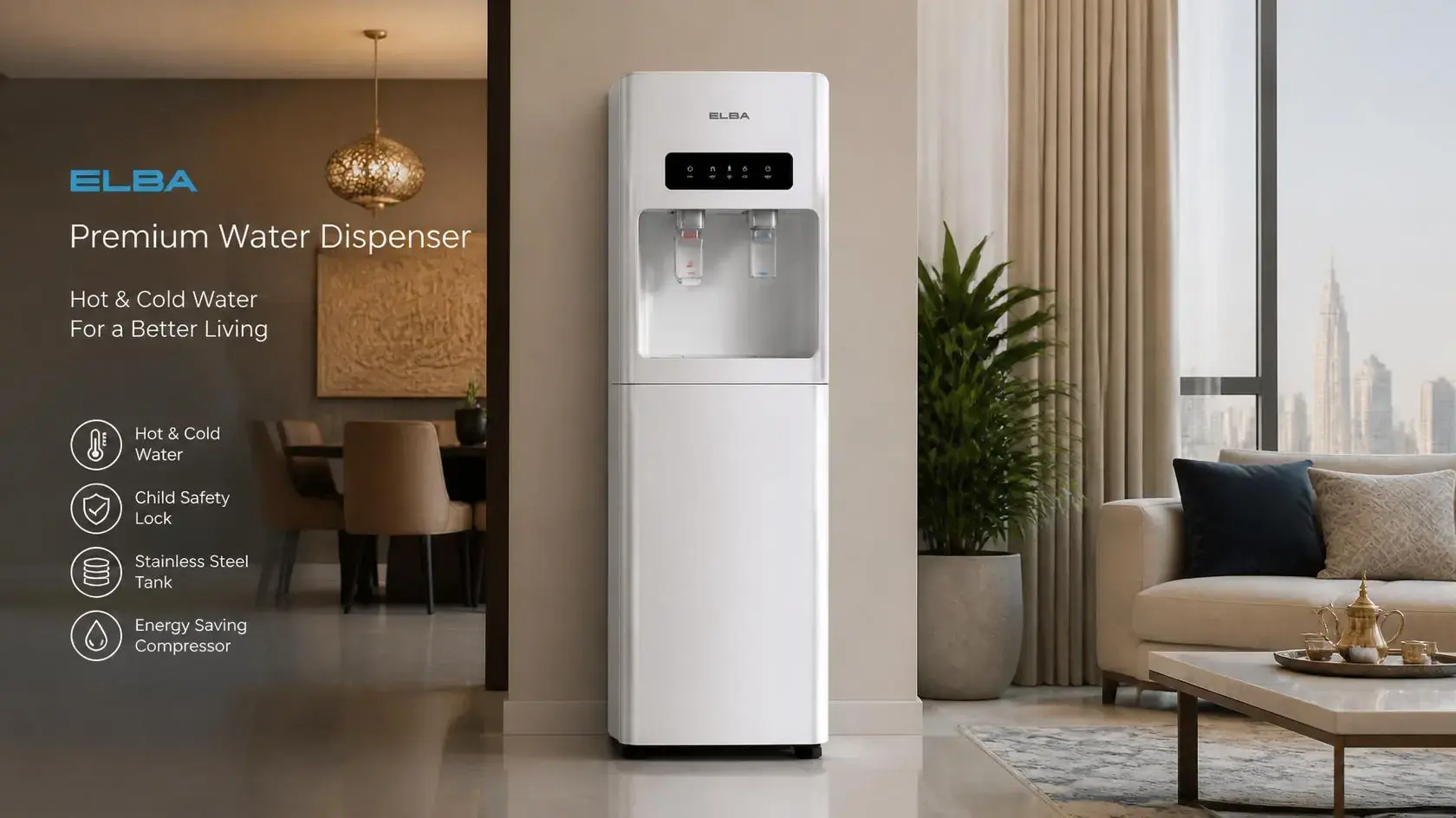
The classic Saudi apartment staple. A vertical unit roughly 120cm tall with the bottle sitting on top, neck-down, feeding water into an internal reservoir. Hot and cold taps on the front. Sits on the floor and takes up approximately 30cm × 30cm of floor space.
What works well: Hot water is genuinely hot — 85°C to 95°C — ready instantly for tea, coffee, or Maggi. Cold water is properly chilled, not just room temperature. No lifting the bottle above head height — the bottle loads at chest level and drops into the collar. Widely available with a 2-year Saudi warranty from Tamkeen, Almanea, and Amazon.sa.
What does not work well: Takes up permanent floor space in a small kitchen. The hot water tank draws continuous electricity to stay at temperature — typically 500W to 700W running constantly. In a compact apartment where kitchen space is already tight, the footprint is noticeable. Also — loading an 18.9-litre bottle (which weighs approximately 19kg) at chest height still requires a solid lift and a steady hand. Spilling at load time is a rite of passage for every first-time user.
Best for: Families, households that drink a lot of hot and cold water daily, apartments with a dedicated kitchen corner to spare.

- Stainless steel for hot and cold water tanks
- Hot, cold and normal water options
- Double safety device for preventing overheat
Type 2 — Bottom-loading dispenser
Same footprint and function as the top-loader, but the bottle sits inside a cabinet at the base of the unit and a pump draws water up to the dispensing taps. No lifting required — you slide the bottle in at floor level, connect a probe, and the machine does the rest.
What works well: Solves the loading problem completely. Sliding a 19kg bottle along the floor is dramatically easier than hoisting it above your head. No spillage at load time. The top of the unit is flat and usable as a counter surface. Visually cleaner — the bottle is hidden inside the cabinet, not sitting on top.
What does not work well: More expensive than top-loaders for equivalent performance. The internal pump is an additional mechanical component that can fail — and in Saudi Arabia’s dust and heat environment, pump failures are more common than manufacturers’ specifications suggest. Replacement parts are not widely stocked locally; if the pump fails outside warranty you are typically buying a new unit.
Best for: Anyone with back problems or who lives alone and cannot safely hoist an 18.9-litre bottle. Apartments where aesthetics matter.

- 【Bottom Loading】 No heavy lifting required. The convenient bottom loader design saves you time as well as effort, making…
- 【Hot/Cold/Ambient Temperature】 Drinking water, three ways. Choose from three waterspouts for a choice of hot, room tempe…
- 【Wide Applycation】Countertop Top Loading Water Cooler Dispenser features a compact design. It can be placed in office, i…
Type 3 — Countertop top-loading dispenser
A compact version of the freestanding top-loader, designed to sit on a kitchen counter or table rather than the floor. Typically 45cm to 55cm tall with the bottle loading at the top. Same hot and cold tap functionality, smaller internal reservoir, smaller bottle — usually takes a 5-litre or 11.3-litre bottle rather than the full 18.9-litre.
What works well: Genuinely compact — fits on a kitchen counter without consuming floor space. Lighter bottles mean easier loading. Good for a single person or couple who go through water at a moderate pace. One model currently available on Amazon.sa delivers hot water up to 85°C alongside cold water and takes the standard 18.9-litre bottle despite its compact footprint.
What does not work well: Smaller reservoir means the cold water runs out faster during heavy use. Counter space in Saudi apartment kitchens is already at a premium — adding a 55cm unit competes with your microwave, your kettle, and whatever else is on the worktop.
Best for: Singles and couples in studio or one-bedroom apartments. Secondary dispenser for a bedroom or home office.

- 【HIGH QUALITY MATERIAL】: Crafted With Food-Grade Contact Liner, This Countertop Water Filter Dispenser Ensures A Healthy…
- 【THREE ADJUSTABLE TEMPERATURES】: This Hot And Cold Water Dispenser Caters To All Seasons With Its Ice-Hot Function, Effo…
- 【TOUCHLESS DISPENSING】:Experience The Simplicity Of Hands-Free Operation With Large, Button-Free Paddles That Make Pouri…
Type 4 — USB rechargeable bottle pump
Not a dispenser in the traditional sense — a small motorised pump that sits on top of a standard Berain bottle and dispenses water with a button press. No hot water function. No cold water function. No electricity socket required — charges via USB-C and runs on battery for weeks per charge.
What works well: Near-zero cost, near-zero footprint. Costs under SAR 50. Takes up no floor or counter space. No electricity draw. Takes five seconds to move between rooms. Eliminates the pouring and spillage problem entirely without buying any appliance.
What does not work well: Room temperature water only — no heating, no chilling. No hot water for tea or coffee. If you want cold water you need to refrigerate the bottle separately. Battery dependent — if it dies mid-use you are back to manual pouring until it charges.

- 💦【ELECTRIC WATER PUMP DISPENSER WITH RECHARGEABLE BATTERY】Water Jug Pump with Rechargeable Battery Inside, be used for 3…
- 💦【HIGH COMPATIBILITY】 This drinking water pump is suitable for gallon barrels with a 2.16-inch (5.5cm) neck. Please conf…
- 💦【EASY TO USE】 5 gallon water pump,Press the button to pull out the water, press again to stop pumping,allows you enjoy …
Best for: Expats on a tight budget, people in furnished apartments with no space for a freestanding unit, anyone who primarily drinks room temperature or refrigerated water and does not need hot water on demand.
I covered USB pumps in detail in a separate post — including which specific models on Amazon.sa are worth buying and which ones fail within weeks. Read the full USB water pump guide for Saudi apartments before buying in this category.
Side-by-side comparison
| Type | Price Range (SAR) | Hot Water | Cold Water | Floor Space | Bottle Loading | Best For |
|---|---|---|---|---|---|---|
| Freestanding top-loader | 280 – 700 | Yes — 85°C+ | Yes — chilled | ~30×30cm floor | Chest height lift | Families, heavy daily use |
| Bottom-loader | 450 – 550 | Yes — 85°C+ | Yes — chilled | ~30×30cm floor | Floor level slide | Back problems, aesthetics |
| Countertop top-loader | 180 – 380 | Yes — 85°C+ | Yes — chilled | Counter space | Counter height lift | Singles, small apartments |
| USB bottle pump | 30 – 50 | No | No | Zero | No lifting needed | Budget, minimal space |
The Saudi-specific buying checklist
Before buying any dispenser on Amazon.sa, check these four things specifically — generic product listings rarely cover them:
Voltage compatibility: Saudi Arabia runs on 220–240V, 50Hz. Most dispensers sold on Amazon.sa are already configured for the Saudi grid, but verify this on the product spec sheet before purchasing. A dispenser shipped from a 110V market and used on a 220V socket will destroy its heating element immediately — similar to what happens to unprotected electronics brought from the US.
Warranty and local service: Buy from a seller offering a Saudi warranty, not a global one. Tamkeen, Almanea, and Shaker Group all stock water dispensers with local service coverage. Amazon.sa fulfilled listings from established Saudi sellers are the safest option. A dispenser that fails three months in with no local warranty means buying a replacement.
Bottle compatibility: All Saudi 18.9-litre bottles (Berain, Masafi, Al Ain, Safa) use a standardised neck diameter — virtually every dispenser listed on Amazon.sa is compatible. If you buy a dispenser designed for a non-standard bottle size (some imported models are calibrated for 3 or 5 gallon US bottles with a slightly different neck), you will have a fitment problem.
Electricity consumption: The hot water tank in a freestanding or bottom-loading dispenser runs continuously. Check the wattage in the product spec — 500W to 700W is standard. Multiply by your daily hours and your Saudi Electricity Company (SEC) rate to estimate the monthly addition to your bill. For a single person who drinks minimal hot water, the countertop model or USB pump may be genuinely more economical.
What I actually use
I don’t actually use any of these four dispenser types anymore. After calculating the monthly toll of hauling 19kg Berain bottles up the stairs to my Al Rawdah apartment and dealing with the continuous plastic waste, I decided to look for a more permanent solution.
In June 2026, I purchased and installed an iSpring RCC7 Under-Sink RO system from Amazon.sa for around SAR 800. Since I have a professional background as an electrician, the under-sink installation was straightforward and took me roughly 90 minutes. It brought my tap water TDS down from a harsh 480 ppm to a clean 16 ppm output, completely eliminating the need to buy or store water bottles in my kitchen.
If you are a renter and your landlord absolutely objects to any under-sink modifications, or if you simply prefer sticking to bottled water, I highly recommend opting for the Type 2 Bottom-loading dispenser to save your back from the constant lifting strain. But if you want a low-cost, space-saving shortcut just for bottle management, take a look at my separate USB water pump guide where I review the sub-SAR 50 models that actually survive Riyadh’s conditions.
Frequently asked questions
No. All four types in this post are freestanding appliances that plug into a standard wall socket. They leave no marks, no modifications, and no permanent changes. Take the dispenser with you when your lease ends. No landlord conversation required.
Every Tamimi, Danube, Panda, and Carrefour stocks 18.9-litre water bottles. Most baqqalas within walking distance of any Riyadh residential area also stock them. Expect to pay SAR 8 to SAR 14 per bottle depending on brand and location. Some buildings have a water delivery service arranged through the building manager — ask your haris if this is available.
Yes — significantly. Commercial bottled water brands in Saudi Arabia typically read between 40 and 200 ppm TDS, compared to my Al Rawdah tap reading of 480 ppm. However, for a permanent lower-cost solution, an under-sink RO filter brings your tap water down to 10 to 40 ppm at a fraction of the ongoing bottle cost. Read my RO filter guide for Saudi Arabia for the full comparison.
You can physically pour Zamzam water into a top-loading dispenser — it will function normally. However, Zamzam water is typically used in small quantities for its religious significance, not as a daily bulk drinking supply. Mixing it into a large dispenser reservoir alongside regular bottled water is a personal decision.
Dispenser reservoirs accumulate bacterial growth in Saudi Arabia faster than in cooler climates due to the ambient heat. Clean the internal reservoir every four to six weeks — most manufacturers include a cleaning plug at the back. Fill the reservoir with a diluted food-safe sanitiser solution, let it sit for 20 minutes, drain, and rinse with two full reservoirs of clean water before resuming normal use. Never use bleach in a dispenser you will drink from.
For a single person living alone who has to load 19kg bottles without help, the answer is yes — the back strain difference is significant. For a household of two or more adults who can assist with loading, the top-loader at SAR 280 to 350 does the same job for considerably less money.
Related reading
If you are dealing with the broader water quality problem in your Saudi apartment, start with my post on Saudi tap water TDS by city — it explains why Riyadh tap water reads 480 ppm and what that number means for every appliance in your kitchen.
For the shower side of the same problem, read my breakdown of the best shower filters for Riyadh hard water — the single fastest upgrade to daily comfort in a Saudi apartment.