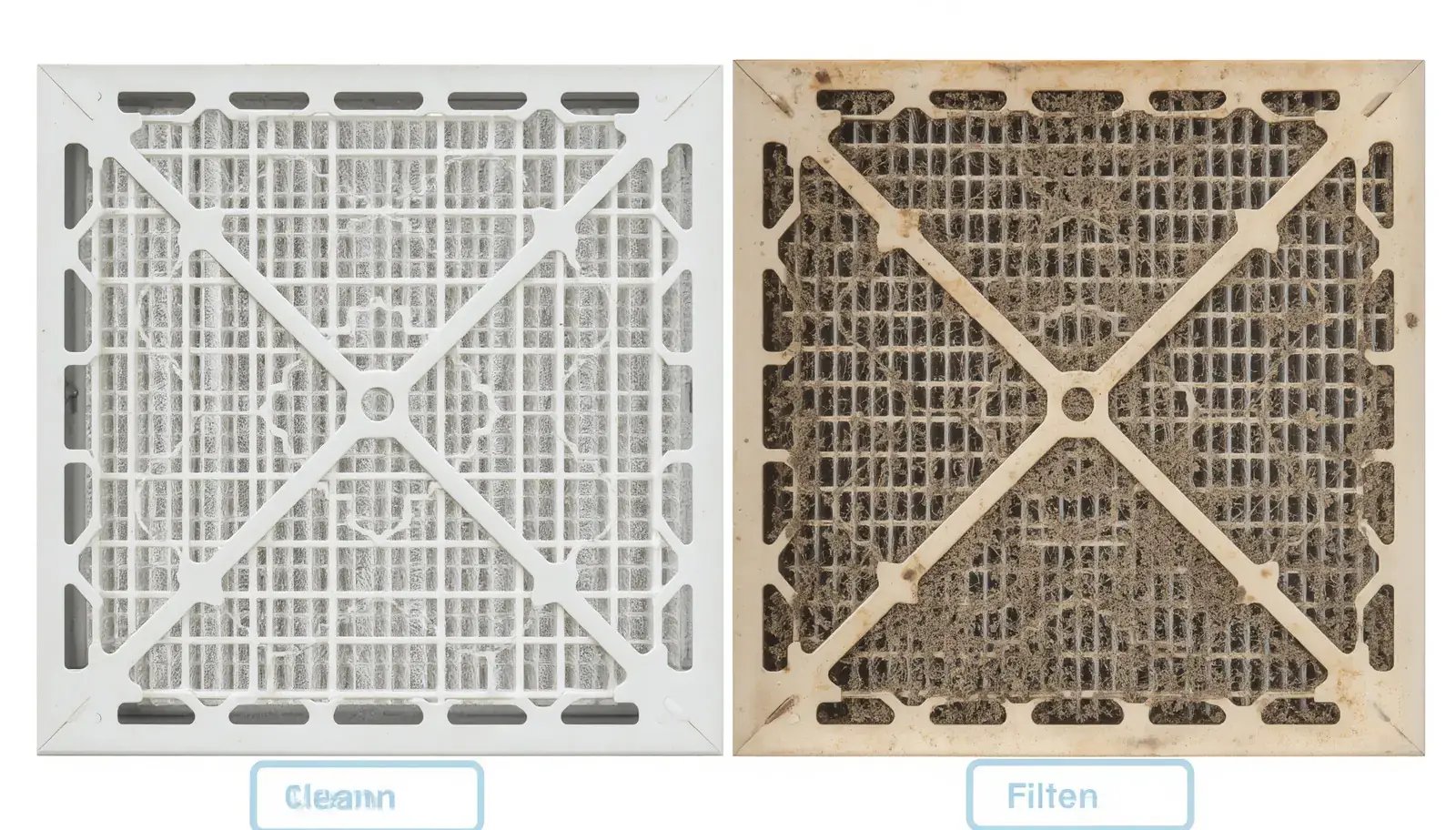
My bedroom split AC was blowing warm air at two in the afternoon in July. Breaker hadn’t tripped. Compressor sounded fine from outside. I popped the front panel expecting nothing — and the mesh filter behind it was a solid gray-brown mat. You couldn’t see a single hole in it. That filter had been “cleaned” six weeks earlier, by the book, on the manufacturer’s own schedule.
That’s the moment I stopped trusting the sticker on the box and started timing it myself. As an electrician working apartments and villas across Riyadh, I get called out for “broken AC” more often than almost anything else — and a shocking number of those calls end with me pointing at a filter, not a compressor. So for 60 days I tracked exactly how fast a split AC filter clogs in real Saudi dust, what the warning signs look like before the unit fails, and which cleaning tools actually held up.
Why Your Split AC Filter Clogs Faster in Riyadh Than Anywhere Else
Every split AC sold in Saudi Arabia ships with the same flimsy plastic mesh filter, and the box usually says “clean every 3 months.” That number was written for a house in a temperate country with grass outside the window. It was not written for Riyadh.
Three things stack against you here that don’t exist most other places:
- Continuous runtime. Your AC isn’t running a few hours a day — during summer it’s often on 16 to 20 hours straight, every day for five to seven months. More airflow through the filter means more dust loaded onto it, faster.
- Fine, dry, abrasive sand. Coastal humid dust clumps and drops. Dry desert dust stays airborne and gets pulled straight through every gap in a window frame or door seal.
- Shamal winds and sandstorms. A single dust event can dump more particulate on a filter in one afternoon than a normal week does anywhere else.
The standard mesh filter inside a split AC isn’t even designed to stop this. It’s built to catch big debris like pet hair and protect the indoor coil — not fine desert sand. Once it’s caked, dust doesn’t just sit on the surface; some of it pushes past and lands directly on the evaporator coil, which is a much more expensive problem to fix than a filter.
How Often You Actually Need to Clean It (Forget the 3-Month Sticker)
Over my 60-day log, here’s roughly what I saw on a bedroom split AC running 10+ hours a day in central Riyadh:
| Days since last clean | Filter condition |
|---|---|
| 0–7 days | Light gray haze, airflow still strong |
| 14 days | Visible dust layer, slight airflow drop |
| 21–30 days | Caked, brown, airflow noticeably weaker |
| 45+ days | Solid mat, AC struggling to cool the room |
That tracks with what HVAC technicians across the Gulf are already telling residents: in dusty climates, a 2-to-4-week cleaning interval is the realistic standard during peak summer, not the 90-day window printed on the box. Window units clog even faster than split units because their filters are smaller.
My personal rule on every unit I service now: check every 2 weeks, clean by week 3 at the latest. If you’ve got construction nearby, a ground-floor apartment, or pets, cut that down further.
The Warning Signs I See on Every Service Call
You don’t need to pull the panel every two weeks to know something’s wrong. Watch for:
- Weaker airflow from the vents — the most reliable early sign
- The room takes noticeably longer to cool at the same thermostat setting
- A musty or stale smell when the AC kicks on
- Ice forming on the indoor coil (visible if you remove the filter) — this means airflow is so restricted the coil is freezing instead of just cooling
- Your SEC bill jumps with no other change in usage
The U.S. Department of Energy notes that a dirty filter forces the system to work harder and use more energy to do the same job — and in a Riyadh summer with the AC running nearly nonstop, that inefficiency compounds fast across a billing cycle.
This post contains Amazon affiliate links. If you buy through them, I earn a small commission at no extra cost to you. I only recommend gear I have personally used on the job in Riyadh.
Gear I Tested for Keeping Filters Clean Between Washes
| Product | Best For | Type | Price (SAR) | My Honest Downside |
|---|---|---|---|---|
| Cordless Compressed Air Duster | Quick dust blasts without water | Rechargeable electric blower | ~125–150 | Doesn’t remove caked-on grime, only loose dust |
| Universal Cut-to-Fit AC Filter Mesh Roll | Retrofitting a finer mesh than the stock filter | Replaceable mesh sheet | ~40–120 | Have to trim it yourself; sizing isn’t always exact |
| No-Rinse AC Coil & Filter Foam Cleaner | Monthly deep clean of filter + visible coil | Foaming aerosol spray | ~50–150 | Strong chemical smell for a few hours after use |
| Soft-Bristle Filter Cleaning Brush Set | Gentle scrubbing without tearing the mesh | Manual brush, 2–3 sizes | ~25–35 | Slower than the air duster for routine dusting |
How I Actually Clean a Split AC Filter (Step by Step)
- Turn off the unit at the breaker, not just the remote. You’ll have your hands inside the housing.
- Open the front panel and slide the mesh filter out — most Saudi-market split units have it sitting right behind the front grille, no tools needed.
- Vacuum or air-blast the loose dust off first, outside if possible. Doing this over a sink just clogs the mesh with wet paste.
- Rinse with lukewarm water from the back side so dust flushes out the way it came in, not deeper into the weave.
- Let it dry completely before reinstalling — a damp filter going back into a closed, humid unit is how you grow mold instead of preventing it.
- Wipe the visible part of the coil gently while the panel’s open if you see dust on it; don’t force anything bent or you’ll restrict airflow further.
What I Use Now
After two months of this, my routine settled on the cordless air duster for a 2-week quick pass and a full water rinse every 3–4 weeks during peak summer. The foam coil cleaner comes out once a month, mainly because I’m in and out of other people’s units all day and want something fast that doesn’t require me to carry a sink’s worth of water to every job.
If you only buy one thing from this list, get the air duster — it’s the difference between a 5-minute habit you’ll actually keep up and a chore you’ll skip until the AC stops cooling.
Frequently Asked Questions
Every 2 to 4 weeks during peak summer for split and window units, especially if you’re running the AC most of the day. The “every 3 months” advice on the box is written for non-desert climates.
You can, but you shouldn’t. Without it, dust goes straight onto the evaporator coil, which is far more expensive and difficult to clean than swapping or washing a filter.
Reduced airflow, weaker cooling, a higher electricity bill, and eventually coil icing or a system that struggles to start. It also recirculates dust and allergens straight into the room you’re sleeping in.
Washable mesh filters (the type in almost every Saudi split AC) are fine if you actually wash them on schedule. If you tend to forget, a cut-to-fit replaceable mesh you swap rather than scrub can be easier to stay consistent with.
Yes. A clogged filter makes the compressor work harder for the same cooling result, which is wasted electricity every single hour the unit runs — and in Riyadh summer, that’s most of the day.
If your AC is already struggling with the dust outside, it’s worth checking what’s happening on the inside of your car too — I covered the heat side of this problem in my guide to the best custom-fit car sun shades in Saudi Arabia, and if dust is your bigger enemy at home as well as in the car, my breakdown of the best air purifiers in Saudi Arabia for desert dust covers the indoor side of the same fight.



Leave a Reply