
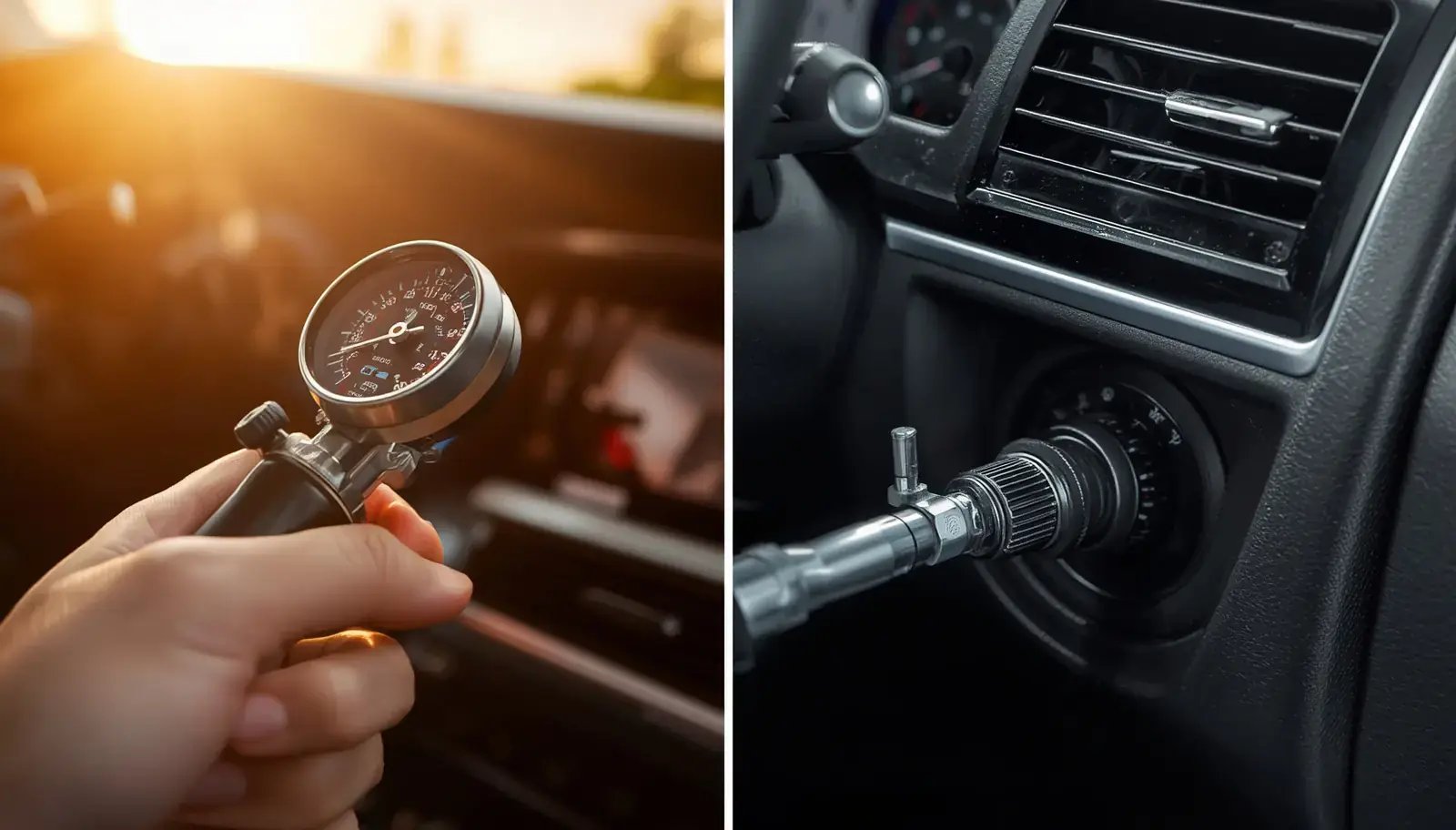
I know what it’s like to sit in a car that’s supposed to be cooling you down and instead just recirculates hot, useless air while the outside temperature reads 112°F on the dash. That’s not a Riyadh problem, that’s an Arizona, Texas, Nevada, or Florida problem too — the same brutal sun, the same baked interiors, the same AC systems getting pushed past what they were built for. I spend my working life testing gear that has to survive extreme heat, and this year I put five of the most popular DIY car AC recharge kits through their paces to see which ones actually bring the cold air back and which ones are a waste of money.
Why Car AC Fails Faster in Hot States
Every AC system loses a small amount of refrigerant over time through microscopic permeation in hoses and seals — that’s normal. But in places like Phoenix, Las Vegas, and Dallas, the failure timeline speeds up dramatically. Constant UV exposure hardens and cracks the rubber O-rings and hose fittings that seal the system, which is one of the most common starting points for a slow leak. Long idle periods in drive-thru lines or school pickup also hurt, because the compressor is working at low RPM under maximum load — the worst combination for a system that’s already stressed by outside temperatures well over 100°F.
On top of that, a parked car in direct summer sun in a hot state can reach interior temperatures far beyond the outside air, which is part of why a weak AC system feels so much worse the moment you get in.
If you’ve already tackled sun exposure with a windshield shade — see my breakdown of custom-fit car sun shades that actually survive extreme heat — a recharge kit is the next logical step when the cold air itself isn’t cutting it anymore.
Signs You Actually Need a Recharge (Not a Mechanic)
A recharge kit is a fix for one specific problem: refrigerant that has slowly leaked out over months or years. It will not fix a broken compressor, a major leak, or a stuck blend door. Before you buy one, check for these signs:
- Air is noticeably weaker or warmer than it used to be, but the system still blows some cool air
- The compressor clutch isn’t cycling on and off with a light click when you turn the AC on
- Vent temperature on a 90°F+ day is well above the 35–48°F range a healthy system should hit
- The AC was cold last summer and has gradually gotten worse — not a sudden failure
If your AC went from cold to completely warm overnight, or you hear a loud clunk from under the hood, that’s very likely a compressor or major leak issue a recharge kit won’t touch — skip straight to a mechanic.
Comparison Table: Car AC Recharge Kits Tested for Hot Climates
| Product | Refrigerant Type | Gauge Type | Leak Sealer Included | Price (USD) | Best For |
|---|---|---|---|---|---|
| A/C Pro Ultra Synthetic w/ Digital Gauge | R-134a | Digital | Yes | 39$ OR 147 SAR | Most drivers wanting an accurate, guesswork-free charge |
| A/C Pro Cold Front Performance | R-134a | Analog | Yes | 59$ OR 224 SAR | Budget-conscious buyers who don’t mind reading a dial |
| Interdynamics EZ Chill w/ Sealant | R-134a | Analog | Yes | 29$ OR 111 SAR | Older vehicles with minor, slow leaks |
| ZEROR 12FT Recharge Hose w/ Gauge (kit only, no can) | Universal fit | Analog | No | 50$ OR 189 SAR | Anyone who buys refrigerant separately and refills |
| R-1234yf Recharge Kit (2015+ vehicles) | R-1234yf | Digital | No | 155$ OR 585 SAR | Newer vehicles that don’t use R-134a |
What I Use Now: My Pick
After testing, the A/C Pro Ultra Synthetic kit with the digital gauge is what stays in my trunk. The digital readout removes the guesswork of squinting at an analog dial on a bright desert afternoon, and the built-in leak sealer bought extra life on a system with a slow, minor leak. On a 108°F day, vent temperature dropped from a barely-there 68°F down into the mid-40s within about ten minutes of careful charging.
The one real downside: it will not diagnose why you’re losing refrigerant. I used a UV dye and flashlight afterward to confirm a small leak at a hose fitting, which I’ll eventually need a shop to reseal properly. A recharge kit buys you a season, not a permanent fix.
Step-by-Step: Recharging Your Car’s AC Safely in Extreme Heat
- Park in shade if at all possible — charging in direct sun skews your pressure readings.
- Start the engine, set AC to max cold, fan on high, and select recirculate.
- Locate the low-pressure port — it’s on the larger of the two aluminum lines running from the compressor, usually capped with an “L.”
- Never connect to the high-pressure port. It runs at dangerously high pressure and can cause the can to rupture.
- Attach the hose and add refrigerant in short bursts, watching the gauge climb into the recommended range for your ambient temperature (check the chart printed on the can).
- Stop as soon as vents blow cold and the gauge sits in the correct zone. Overcharging is just as bad as running low — it strains the compressor and can actually make the air blow warmer.
- Wear safety glasses and gloves the entire time. Refrigerant under pressure can cause frostbite-like burns on skin.
If two cans in and the gauge still won’t climb, stop — that’s a sign of a real leak, not something a home kit can fix.
R-134a vs. R-1234yf: Check Your Refrigerant First
Most vehicles built before 2015 use R-134a. Many newer vehicles (roughly 2015 onward) switched to R-1234yf, which is a different chemical and requires a different kit with different fittings — they are not interchangeable. Check your under-hood sticker or owner’s manual before buying anything. Using the wrong refrigerant can damage the system and will not solve your cooling problem.
FAQ
Yes, as long as you work in shade, follow the pressure chart for your ambient temperature, and never overcharge the system. Extreme heat means you should be extra careful not to exceed the recommended pressure range, since heat itself raises system pressure.
If your system is otherwise healthy with no leaks, refrigerant shouldn’t need topping off more than once every year or two. Needing a recharge every few months is a strong sign of a leak that needs a proper repair, not another can.
Only if the root cause is low refrigerant. If the compressor clutch isn’t engaging at all, or you hear grinding, a recharge kit won’t help — that’s a compressor or electrical issue.
The compressor does add load to the engine, which matters most in stop-and-go traffic or climbing grades. For normal daily driving, a well-maintained cooling system handles it fine.
That’s usually a failing condenser fan — the condenser needs forced airflow when you’re not moving, and a weak or dead fan shows up exactly in stop-and-go conditions.
