Affiliate disclosure: This post contains affiliate links to Amazon.sa. If you buy through them, Tabaix may earn a small commission at no extra cost to you. We checked every bottle below individually on Amazon.sa; prices appear only on the live product cards, since they change too often to print honestly.
Kids water bottles in Saudi Arabia have a harder job than anywhere else
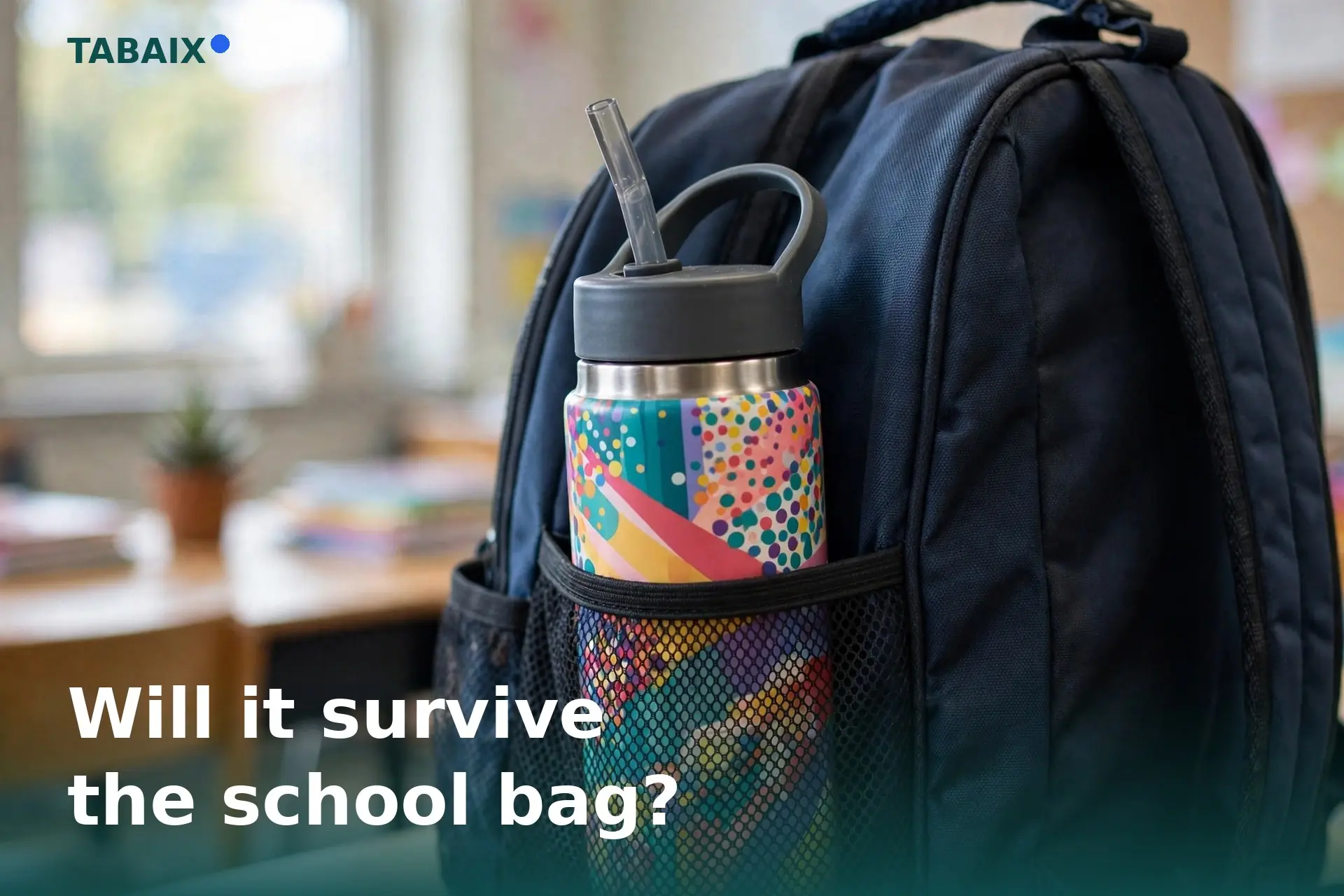
A child’s school day here is not gentle on kids water bottles. The bag sits in a hot car or a sun-baked bus, gets dropped on tiles, swung by its handle, and opened a dozen times by small, impatient hands. By the afternoon break the playground can still be well above 40°C, and water that went in cold at 7 a.m. needs to still be worth drinking at 1 p.m. And one weak seal is all it takes for a soaked copybook, a damp uniform, and a very annoyed teacher.
So a school bottle here has to pass four tests at once: no leaks inside the bag, water still drinkable through a long hot day, materials you are comfortable with, and a design your child can actually open, carry and clean. This guide covers only children’s school bottles. Shopping for yourself instead? Start with our guide to bottles for adults in the summer heat: summer water bottle guide.
Quick picks
- Best for cold water all day: THERMOS FUNTAINER 355 ml — vacuum-insulated steel, pop-up straw (ages ~3–7).
- Best leak-proof spout: Contigo Kids AUTOSPOUT 14 oz — sealed valve design in light BPA-free Tritan.
- Best first school bottle: b.box Drink Bottle Jnr 13 oz — free-flow straw and a handle for little hands.
- Best easy-clean steel: Ion8 Leak Proof Kids 400 ml — dishwasher-safe steel, triple-lock seal.
- Best budget big size: ECVV Kids Water Bottle 500 ml — flip lid with safety lock and handle.
- Best for older kids: Dzannc Insulated 550 ml — vacuum-insulated 18/8 steel, rotating handle.
How to choose a school water bottle
Start with size — by age, not by guesswork
Too small, and it’s empty before the second break; too big, and it becomes dead weight a small child stops carrying. As a working guide: ages 3–5 do well with 350–380 ml, covering a kindergarten morning with one refill. Ages 5–8 are the 400–420 ml sweet spot — enough for a full primary day in most cases. From about age 8, or for long days with after-school sports, look at 500–550 ml. Weight matters as much as volume — a filled 550 ml steel bottle is a serious lump in a grade-two bag.
The lid decides whether the bag stays dry
Almost every school-bag flood traces back to the lid, not the bottle body. Push-button straw lids are easiest for young children — press, sip, press again — but check the straw seals or retracts when closed. Flip-top lids with a separate safety lock suit older kids who throw bags around, since the lock stops the lid popping open against books. Whatever you pick, do the shake test at home, bottle upside down over the sink, before it ever goes in the bag.
Tritan vs insulated steel in 45°C heat
This is the real Saudi question. BPA-free Tritan bottles (like the Contigo below) are light, tough and see-through, so you can check the water level. But plastic doesn’t insulate: water filled cold in the morning is warm by midday in a hot bag — and warm water is exactly what children refuse to drink. Vacuum-insulated stainless steel (the THERMOS and Dzannc below) genuinely keeps water cold all school day, which in this climate is the difference between a hydrated child and one who comes home with a headache. The trade-offs are weight, price and opacity. Single-wall steel (the Ion8) sits in between — durable and easy to clean, but no cooling. Whichever you choose, check for an explicit BPA-free statement on the plastic lids and straws of steel bottles too, not just the body.
Cleaning: the hidden deal-breaker
School bottles grow slime in straws and lid corners faster here, because they live warm and damp. Prefer bottles that come fully apart — lid, straw, seal — and check whether the listing says dishwasher safe or hand wash only: that decides whether cleaning is a 2-minute job or a chore that gets skipped. A straw brush is worth more than any feature on the box.
Straps, handles and the name label
An integrated handle or strap is not decoration: it’s how a five-year-old carries a bottle without dropping it — and dropping is how lids crack. And in any classroom there will be three identical bottles on the shelf: put your child’s name on theirs with a waterproof label on day one, or accept it coming home as somebody else’s.
The bottles, one by one
1. THERMOS FUNTAINER 355 ml — the cold-water classic

- THERMOS vacuum insulation technology for maximum temperature retention, not for use with hot liquids
- Durable stainless steel interior and exterior
- Hygienic push button lid with pop-up straw and integrated carry handle
Who it’s for: roughly ages 3–7, and any parent whose first priority is water that stays cold until the last break. The FUNTAINER is the kids’ line from THERMOS, the brand that invented the vacuum flask. The listing states vacuum insulation that keeps drinks cold for 12 hours — comfortably a full school day, even if the bag spends the morning in a hot bus.
Strengths: the push-button lid pops up a straw — easy for small hands, and the covered straw stays cleaner than an exposed one. The carry handle is built in, not clipped on, so it survives being swung around. Steel inside and out shrugs off drops that would crack plastic.
Watch-outs: hand washing is recommended, and it’s not for hot liquids. At 355 ml, thirsty older kids will drain it before noon.
2. Contigo Kids AUTOSPOUT 14 oz — the leak-proof specialist

- INTUITIVE DRINKING: To drink, press the button on the front and a straw pops out of the holder; to close, press it back …
- 100% LEAK PROOF: The drinking bottle is leak-proof – guaranteed; a valve prevents liquid leakage even when the straw is …
- ROBUST AND SUSTAINABLE: BPA-free kids’ water bottle made of lightweight, robust Tritan copolyester; sustainable, refilla…
Who it’s for: ages roughly 4–8, especially if last term ended with a soaked school bag. Contigo built this bottle around one promise — the listing describes a valve that prevents leaking even when the straw is popped up, and a cap that covers the spout against dirt.
Strengths: at about 107 g empty, this BPA-free Tritan bottle is far lighter than steel, and you can see the water level through it. The “easy-clean” name is earned: the lid leaves fewer hidden corners for grime. Press-button drinking is genuinely one-handed — useful for a child carrying a tray or book in the other hand.
Watch-outs: Tritan doesn’t insulate — fill it with fridge-cold water (or a little ice) in the morning, because by midday in a hot bag it will be warm. The 14 oz size (about 414 ml) suits primary ages; big drinkers will need a refill.
3. b.box Drink Bottle Jnr 13 oz — best first school bottle

- {Perfect Transition} Designed for big little kids transitioning from sippy cup to drink bottle. Our free flow straw top …
- {Leakproof Design} Enjoy worry-free hydration with a secure, leakproof lid made with materials free from BPA, PVC, and P…
- {Easy to carry + clean} The robust handle ensures little hands can easily grip and carry the bottle, fitting perfectly i…
Who it’s for: the youngest school starters, roughly ages 3–5, moving up from a sippy cup. The listing says it was designed exactly for that transition, with a free-flow straw top that lets small children drink without hard sucking.
Strengths: the materials are listed as free from BPA, BPS, PVC and phthalates. The robust handle is sized for little hands, the bottle is light (122 g), and it fully disassembles and is dishwasher safe — the easiest cleaning routine on this list. A leak-proof lid keeps the preschool bag dry.
Watch-outs: replacement straw tops are sold separately, and straws do wear out, so budget for a spare. Like all plastic bottles here, there’s no insulation — it’s a morning bottle, not an all-day-in-the-heat bottle.
4. Ion8 Leak Proof Kids 400 ml — steel that goes in the dishwasher

- AWARD-WINNING WATER BOTTLES – ION8 bottles have won 3 design awards and are built for active lifestyles. With triple loc…
- DISHWASHER-SAFE STAINLESS STEEL – Made from food-safe, odour-resistant stainless steel, these bottles are durable, easy …
- LIGHTWEIGHT & SLIMLINE – Tough yet light stainless steel makes these bottles durable and perfect for daily use. Slim eno…
Who it’s for: ages roughly 5–9 who are hard on plastic bottles. Ion8 is a UK brand known for locking lids; this kids’ version uses a triple-lock seal with a press-close lid and a secure brace — the listing is emphatic that it won’t leak in the bag.
Strengths: food-safe stainless steel that the listing says is dishwasher safe — a rare, genuinely useful combination, since most steel bottles are hand-wash only. The wide mouth makes refilling quick and lets you add ice cubes or a brush. The slim 400 ml shape fits bag side pockets and car holders.
Watch-outs: read the listing carefully — this is single-wall steel and Ion8 itself states it is not for insulation. Water will reach room (or bag) temperature. Choose it for durability and easy cleaning, not for cold water.
5. ECVV Kids Water Bottle 500 ml — the big budget option

- 【Cute Cartoon Space Design】Features colorful cartoon and space-themed illustrations that make drinking water more fun an…
- 【Convenient 500ml Capacity】Perfect size for daily hydration, providing enough water for school, travel, sports, and outd…
- 【Leakproof Locking Lid】Designed with a secure one-touch flip-top lid and safety lock to help prevent leaks, spills, and …
Who it’s for: ages roughly 6–10 who need a bigger bottle without a bigger price — plus space fans, since a bottle kids like is a bottle kids carry. At 500 ml it’s sized for a full day.
Strengths: the one-touch flip lid has a safety lock to stop it opening accidentally inside a bag — the most useful feature at this size. There’s a carry handle, and at 200 g the empty bottle is light for its capacity. The listing confirms BPA-free materials.
Watch-outs: ECVV does not name the exact plastic type (only “BPA-free”), and there’s no insulation, so this is a refill-as-you-go bottle. As with any budget brand, check the lock and seal when it arrives, and again after the first few drops.
6. Dzannc Insulated Kids Bottle 550 ml — for older kids and long days

Who it’s for: ages roughly 8 and up — bigger children, longer days, after-school sports in the heat. At 550 ml it’s the largest bottle here, and one of only two insulated steel options.
Strengths: the listing specifies double-wall vacuum insulation and 18/8 stainless steel, with BPA-free plastic straw lids. The wide rotating handle is sturdier than fabric straps, and the straw lid means no tipping the bottle up during a match or in the car.
Watch-outs: hand wash only, and a filled 550 ml insulated steel bottle is heavy — check your child’s bag first. Dzannc is a lesser-known brand, so judge it on the seal when it arrives: fill, close, shake upside down over the sink.
Side by side: all six bottles compared
| Bottle | Size | Material | Keeps water cold? | Lid type | Best for |
|---|---|---|---|---|---|
| THERMOS FUNTAINER | 355 ml | Vacuum-insulated stainless steel | Yes — cold up to 12 hours (per listing) | Push-button pop-up straw | Ages ~3–7; cold water all day |
| Contigo Kids AUTOSPOUT | 14 oz (≈414 ml) | BPA-free Tritan | No insulation | Button pop-up straw with sealed valve | Ages ~4–8; leak-proof priority |
| b.box Drink Bottle Jnr | 13 oz (≈380 ml) | BPA/BPS/PVC/phthalate-free plastic | No insulation | Free-flow straw top | Ages ~3–5; first school bottle |
| Ion8 Leak Proof Kids | 400 ml | Single-wall stainless steel | No — reaches bag temperature | Press-close flip lid, triple-lock seal | Ages ~5–9; durability + dishwasher |
| ECVV Kids Water Bottle | 500 ml | BPA-free plastic (type not named) | No insulation | One-touch flip lid with safety lock | Ages ~6–10; big size, small budget |
| Dzannc Insulated | 550 ml | 18/8 stainless steel, vacuum insulated | Yes — double-wall insulation (per listing) | Straw lid, leak-proof | Ages ~8+; long days and sports |
Read the “keeps water cold” column carefully — it is the single biggest dividing line in this list. Two bottles genuinely insulate, four do not, and no amount of wishing changes physics: a non-insulated bottle in a 45°C bag gives you warm water by the second break. Everything else — lids, weight, cleaning — is about which compromise suits your child.
How much water does your child actually need at school?
Parents usually ask about bottle size in millilitres, but the better question is how much water a child should get through between the morning bell and pickup. As a general guide used by paediatric and nutrition references, children aged 4–8 need roughly 1.2–1.6 litres of total fluids a day, and ages 9–13 around 1.6–2.1 litres — from all drinks and food, spread across the whole day. A school day claims about a third to a half of that, and in Saudi heat, with outdoor breaks and PE, the school share sits at the top of the range. Refills change the maths completely, so treat the figures below as “water available during school hours”, not “bottle size, exactly”.
Ages 3–4 (kindergarten)
Short mornings, frequent supervised drinks, and small hands. Aim for about 350–500 ml available across the morning, which a 350–380 ml bottle covers with the teacher’s refill jug as backup. What matters most at this age is not capacity but independence: a lid they can open alone, a straw that doesn’t need hard sucking, and a handle they can grip. A heavy or fiddly bottle simply doesn’t get used, and an unused bottle hydrates nobody.
Ages 5–7 (early primary)
The full school day kicks in, plus the walk to the bus in real heat. Plan on roughly 600–900 ml across the day. A 400–420 ml bottle with one refill at lunch is the pattern that works for most children this age; a 500 ml bottle works if your child reliably finishes and refills are unreliable. This is the age where leaks peak — bags get swung, dropped and sat on — so the seal matters more than any other feature.
Ages 8–12 (upper primary)
Bigger bodies, sports after school, and more independence. Plan on 900 ml to 1.3 litres across a long day, especially on PE days. A 500–550 ml insulated bottle, refilled once, is the practical setup: cold at 7 a.m., still cold at the 1 p.m. refill, and cold again for training. By this age most children can manage flip lids and locks themselves, and many start refusing “babyish” straw designs — a rotating-handle sports-style bottle like the Dzannc survives the image test better than a cartoon print.
Whatever the age, watch the output, not the bottle: a child who comes home with a headache, dark urine or unusual tiredness on school days is telling you the current setup isn’t enough — bigger bottle, colder water, a refill routine, or all three.
One school day at 45°C: what actually happens to the water
7:00 a.m. You fill the bottle from the fridge at about 5°C. If the bottle is vacuum-insulated steel, that temperature is now locked in for hours. If it’s plastic or single-wall steel, the countdown starts immediately.
8:30 a.m. The bag has spent twenty minutes in a hot car or bus. A non-insulated bottle is already at 25–30°C — drinkable, but the “cold” is gone. By the mid-morning break it will be at air temperature, and study after study on children’s drinking habits shows the same simple truth: children drink noticeably less warm water than cold.
1:00 p.m. This is where the day is won or lost. The insulated bottle still pours cold. The non-insulated one is warm — and if it sat in a bag in direct sun, genuinely unpleasantly warm. Two tricks rescue a non-insulated bottle: the frozen-bottle trick (fill it three-quarters full the night before, freeze it on its side, top up with cold water in the morning — it melts steadily and stays cold until around midday) and the side-pocket rule: a bottle in the bag’s outer side pocket, shaded by the bag itself, stays cooler and — just as important — a leak there wets a pocket, not the copybooks. Inside the main compartment, wrapped against black exercise books in a sun-baked bag, is the hottest, riskiest place a bottle can ride.
The bottom line: if your child comes home with water left and complaints that it was “warm and yucky”, the bottle isn’t failing — physics is. Either move to insulated steel for school days, or commit to the freeze-and-top-up routine every single night.
Five buying mistakes we see every September
- Buying too big. A 750 ml bottle for a six-year-old is not generous, it’s ballast. The child drinks less, carries more, and the bottle gets left behind — the worst outcome of all. Match the size to the age bands above.
- Heavy steel for small kids. Insulated steel is the right material with the wrong weight for a four-year-old. A filled steel bottle can be two to three times the weight of the same size in Tritan. Under age 5, keep steel small (355 ml) or choose light plastic and use the frozen-bottle trick.
- Trusting “leak-proof” on the box without testing. Every brand claims it. Sip tops and cheap flip lids still weep under bag pressure. The home shake test — full, closed, upside down, ten seconds over the sink — tells you more than the packaging.
- Dark colours for outdoor-heavy days. A black bottle in Gulf sun absorbs heat its lighter twin doesn’t. It won’t defeat insulation, but on a non-insulated bottle it’s the difference between warm and undrinkable by noon. Light colours and prints are a functional choice here, not just a pretty one.
- Ignoring the straw. The straw and silicone seal are where mould, smell and leaks actually live. If a bottle’s straw can’t be removed and brushed, or the brand sells no replacement tops, its real lifespan is one term, not one year.
Decision guide: if your child…, buy…
- If your child is 3–5 and starting school: the b.box Drink Bottle Jnr — free-flow straw, toddler-proof handle, fully dishwasher safe.
- If cold water until the last break is the priority: the THERMOS FUNTAINER — the bottle that keeps water cold all school day, in a size small kids can carry.
- If last term ended with a soaked bag: the Contigo AUTOSPOUT — a genuinely leak proof school bottle thanks to its sealed valve, and light Tritan for small shoulders.
- If you want steel but hate hand-washing: the Ion8 400 ml — the only dishwasher-safe steel bottle here; accept that it doesn’t insulate.
- If budget matters and the day is long: the ECVV 500 ml — the biggest capacity per riyal on this list, with a locking flip lid; use the frozen-bottle trick for cold.
- If your child is 8+ with sports after school: the Dzannc 550 ml — insulated 18/8 steel sized for long, hot days.
Care and cleaning: keeping school bottles fresh in the heat
A school bottle lives warm, damp and dark — ideal conditions for slime and mould — so cleaning can’t be an occasional event. Use this schedule; it takes under ten minutes a week in total.
Daily (30 seconds): rinse and reset
Empty what’s left — never top up yesterday’s water — rinse the bottle and lid with warm water and a drop of washing-up liquid, shake, rinse again, and leave it upside down to dry overnight with the lid open. Never leave a filled bottle in a hot car or bag “for tomorrow”: empty it, rinse it, start fresh in the morning.
Twice a week (2 minutes): the lid comes apart
Take the lid fully apart — straw out, silicone seal off where it removes — and scrub the straw inside with a thin straw brush and the seal with an old toothbrush. These two parts hold almost all the smell and nearly all the mould you will ever find. If the seal has gone slimy or discoloured, a ten-minute soak in warm water with a spoon of baking soda resets it.
Weekly (5 minutes): deep clean
Once a week, soak bottle and parts in warm water with a spoon of baking soda for 15–30 minutes, scrub, rinse and air-dry completely before closing — sealing a damp bottle is exactly how the musty taste starts. Dishwasher-safe bottles (the b.box and Ion8 above) can take the top rack instead, but hand-wash the seals anyway; dishwasher heat ages silicone.
Mould and smell watch-outs
Black or pink specks inside the straw, a slimy feel on the seal, or a swampy smell that survives washing are the three warning signs. Specks inside a straw that a brush can’t clear mean the straw is done — replace the top if the brand sells spares, or replace the bottle. And a warning every parent learns once: juice, milk and flavoured drinks accelerate all of this dramatically. School bottles are for water; anything else needs a full wash the same evening.
When to replace the bottle
Retire a bottle when the seal stops sealing (it fails the shake test it once passed), the straw is chewed flat or cracked, the insulation stops working (a vacuum bottle that sweats on the outside has lost its vacuum), or the smell survives a baking-soda soak. Straws and seals always wear first. With daily use and daily drops, about one school year is an honest lifespan for most bottles — which is another argument for not overspending on a five-year-old’s bottle.
Frequently asked questions
What size water bottle is right for a 5-year-old?
For most 5-year-olds, 350–420 ml is the practical range. It covers a school morning and lunch with at most one refill, and it stays light enough (under half a kilo filled) for a small child to carry all day. Go bigger only if the school day is long and refills are hard to get.
Is stainless steel or plastic better for school in Saudi heat?
For keeping water cold, insulated stainless steel wins clearly — vacuum insulation holds cold all school day, while plastic and single-wall steel reach bag temperature by midday. For weight, price and seeing the water level, BPA-free plastic (such as Tritan) is better. Many families keep one of each: steel for school, light plastic for sports and outings.
How do I stop the bottle leaking in the school bag?
Choose a lid with a real seal and, ideally, a lock or valve — the Contigo and Ion8 above are built around exactly that. Test at home: fill, close, shake upside down over the sink. Teach your child to close it until it clicks, and carry it upright in the bag’s side pocket, not loose among the books.
Are these bottles BPA-free?
Every bottle in this guide is listed by its seller as BPA-free — that includes the plastic lids and straws on the steel bottles. Where a listing names the material (Tritan, 18/8 stainless steel) we’ve said so; where it only states “BPA-free” without naming the plastic, we’ve said that too, so you can decide with the same information we had.
How often should a school bottle be replaced?
Replace it when the seal stops sealing, the straw is chewed or cracked, or the inside keeps its smell after a baking-soda soak. Straws and seals wear first — some brands sell replacement tops, which extends the bottle’s life. Most school bottles earn retirement after about a school year of daily drops.
Can I freeze water in my child’s school bottle?
Yes — in plastic and single-wall steel bottles it’s the best trick for cold water without insulation: fill three-quarters full (water expands as it freezes), freeze on its side overnight, then top up with cold water in the morning. It melts through the day and stays properly cold until around midday. Be careful with vacuum-insulated bottles, though: most manufacturers advise against freezing the bottle itself, and it gains you little — good insulation already keeps the morning’s cold water cold all school day. Drop in a couple of ice cubes instead.
What makes a school bottle truly leak-proof?
Three things, in order: a silicone seal that seats fully when the lid closes, a lock or valve that keeps the spout shut under pressure (the Contigo’s sealed valve and the Ion8’s triple-lock are the two designs here built specifically for this), and a child who closes it until it clicks. “Leak-proof” on packaging is a claim, not a test — run your own: fill the bottle, close it, hold it upside down and shake for ten seconds over the sink. A leak proof school bottle passes in your kitchen before it ever has to pass in the bag.
Where can I buy a BPA free bottle for kids in Saudi Arabia?
All six bottles in this guide were checked on Amazon.sa, where the BPA free bottle for kids Saudi Arabia search results mix genuine listings with vague ones. Buy using the same checks we applied: the listing itself states “BPA-free” (and ideally names the material — Tritan, or 18/8 stainless steel), the brand is identifiable, and the lid and straw materials are covered by the same statement, not just the body. If a listing can’t say what the bottle is made of, treat that as your answer and move on.
The short version
If you buy one bottle, buy insulated steel in your child’s size — cold water is what actually gets drunk in Saudi heat. The THERMOS FUNTAINER suits younger children, the Dzannc 550 ml older ones, and a light Tritan bottle like the Contigo covers sports days. Travelling as a family? These bottles earn their place in hand luggage too — see our Umrah packing checklist. And before checkout, check today’s deals page, where we collect current Saudi offers.